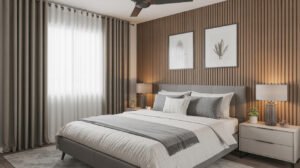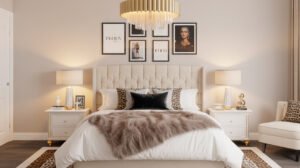
Real talk: I used to think small bedrooms were just… unfortunate. Like, “oh well, I guess I’ll just make do with this shoebox.” Then I moved into a 10×10 bedroom and had a choice—wallow in self-pity or get creative. Spoiler alert: I got creative, and honestly? My small bedroom ended up being more functional and cozier than any larger room I’d had before.
The secret isn’t about making your small bedroom look bigger (though we’ll talk about that). It’s about making every single inch count while still creating a space that feels like a retreat, not a storage unit. Those gorgeous small bedroom ideas you see online? They’re not magic—they’re just smart design choices that anyone can replicate.
Let me show you how to transform your compact bedroom into a space so well-designed that guests will ask for a tour. Because yes, that’s totally a thing that happens now.
Understanding Small Space Design Principles
Before we start buying furniture and drilling holes in walls, let’s talk about the fundamentals. Small bedroom design isn’t just regular design but smaller—it’s a completely different approach.
The Core Philosophy
Small bedroom ideas that actually work are built on these principles:
Vertical thinking: When you can’t go out, go up. Your walls are prime real estate that most people completely waste.
Multi-functionality: Every piece should earn its place by serving multiple purposes. A nightstand that’s just a nightstand? That’s a luxury small bedrooms can’t afford.
Light and reflection: These are your secret weapons for making spaces feel larger and more open.
Intentional minimalism: This doesn’t mean boring or sparse—it means every item is there for a reason and adds value.
Strategic storage: Hidden storage is gold. If it’s not beautiful, it needs to be hidden.
Think of your small bedroom like a tiny house but with fewer building codes and more style opportunities. Every decision matters more when space is limited.
Floating Shelves: Your Small Bedroom’s Best Friend
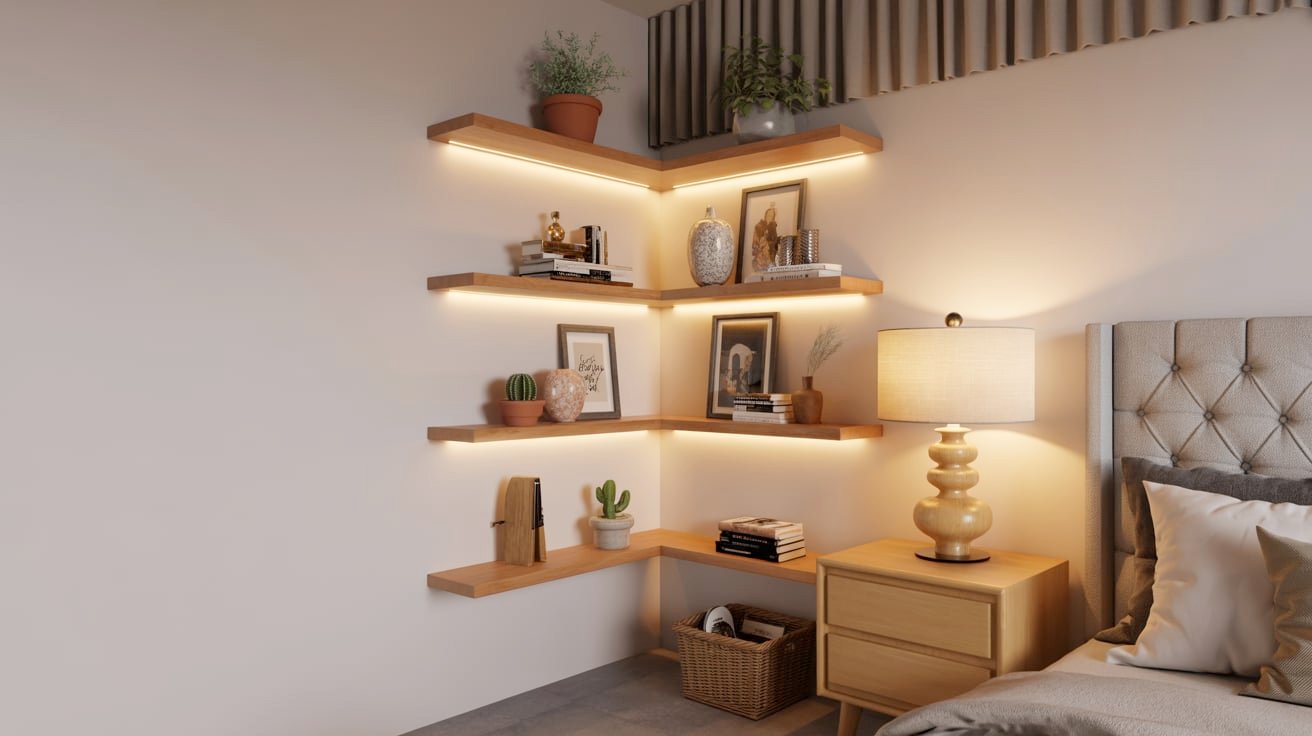
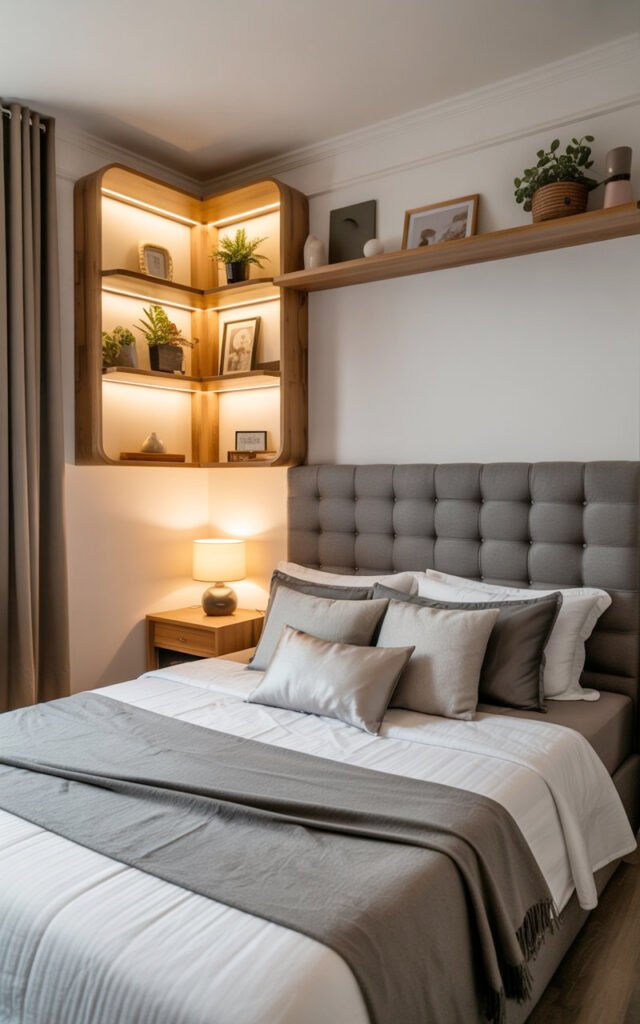
Look at that corner in the inspiration image—those floating shelves with built-in lighting? That’s what I’m talking about. This is the kind of creative decor that changes everything.
Why Floating Shelves Are Perfect for Small Bedrooms
They don’t take up floor space: This is huge. Floor space is your most valuable commodity in a small bedroom.
They add storage without bulk: Unlike bookcases or dressers, floating shelves feel light and airy while providing tons of display and storage.
They draw the eye upward: This makes your ceilings feel higher and your room feel more spacious.
They’re incredibly versatile: Books, plants, decor, storage boxes—whatever you need.
Installing Corner Floating Shelves
Corner shelves (like in the inspo pic) are genius because corners are usually dead space. Here’s how to do it right:
Find the studs: Non-negotiable. Floating shelves need to be anchored properly or they’ll fall and ruin your day (and your stuff).
Start high: Your top shelf should be high enough that you’re not hitting your head but low enough to be useful—usually about 5-6 feet from the floor for the lowest shelf.
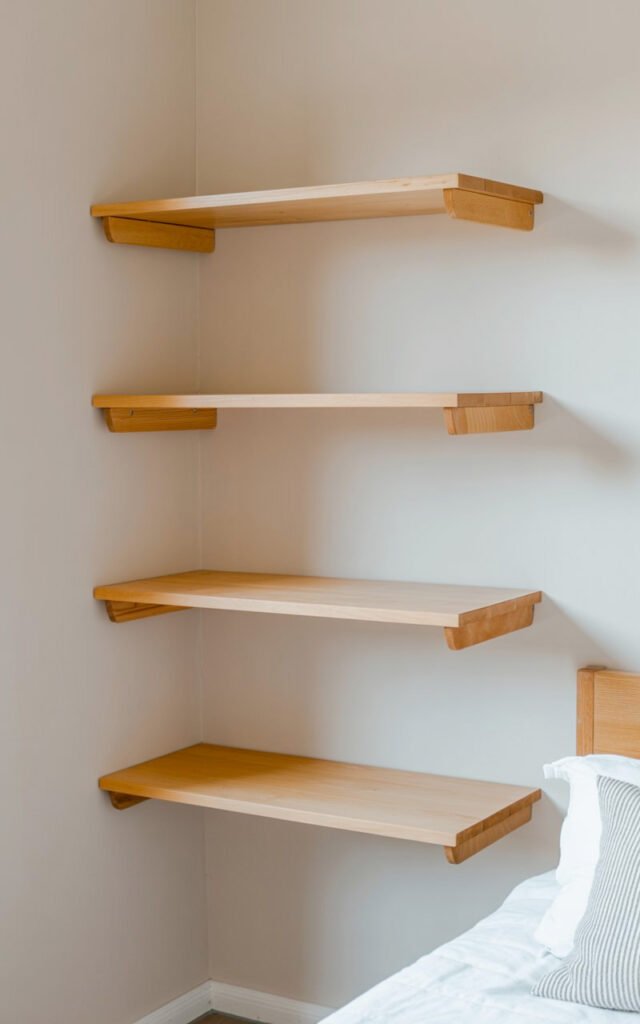
Space them appropriately: 10-12 inches between shelves works for most items. Adjust based on what you’re storing.
Level is critical: Use a good level. Crooked shelves will haunt you forever.
I installed three corner shelves in my small bedroom over a weekend. Cost me about $60 for the shelves and brackets, and it added probably 15 square feet of usable storage/display space. That’s massive in a small room.
Styling Your Floating Shelves
This is where people either nail it or create a cluttered mess. Here’s the formula:
Bottom shelf (most accessible):
- Items you use regularly
- A small plant
- Books you’re currently reading
- A decorative box for small items
Middle shelves:
- Mix of decorative objects (vases, sculptures, photos)
- Plants for life and color
- Grouped books (horizontal and vertical)
- Personal items that tell your story
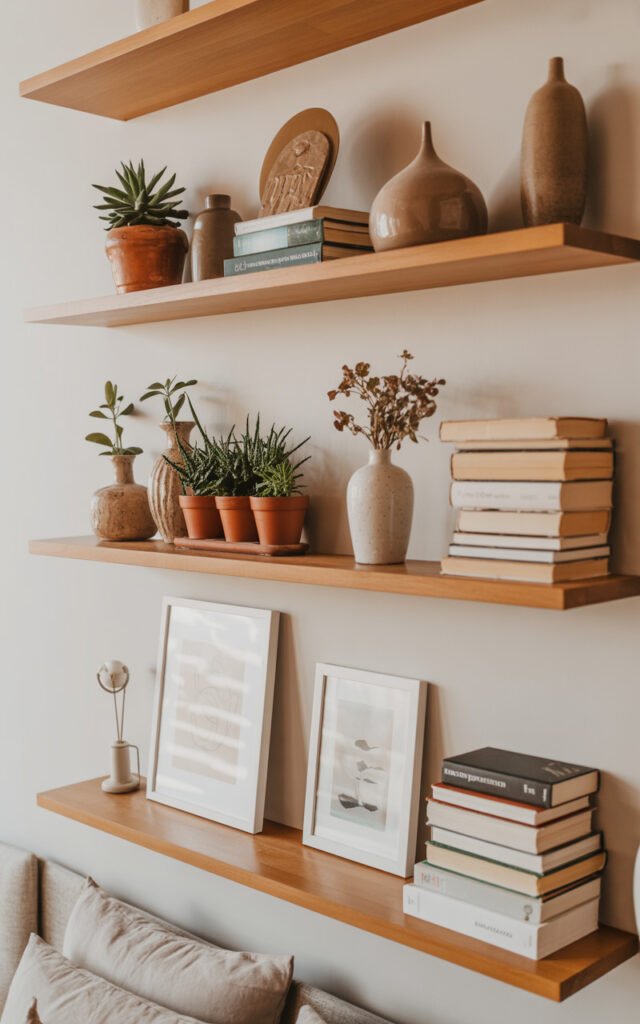
Top shelf (less accessible):
- Decorative items you don’t need to access often
- Trailing plants that can cascade down
- Beautiful storage boxes
- Seasonal decor
The key is varying heights, mixing organic (plants) with structured (books, boxes), and leaving some breathing room. Not every inch needs to be covered.
Accent Lighting: The Game-Changer for Small Bedrooms
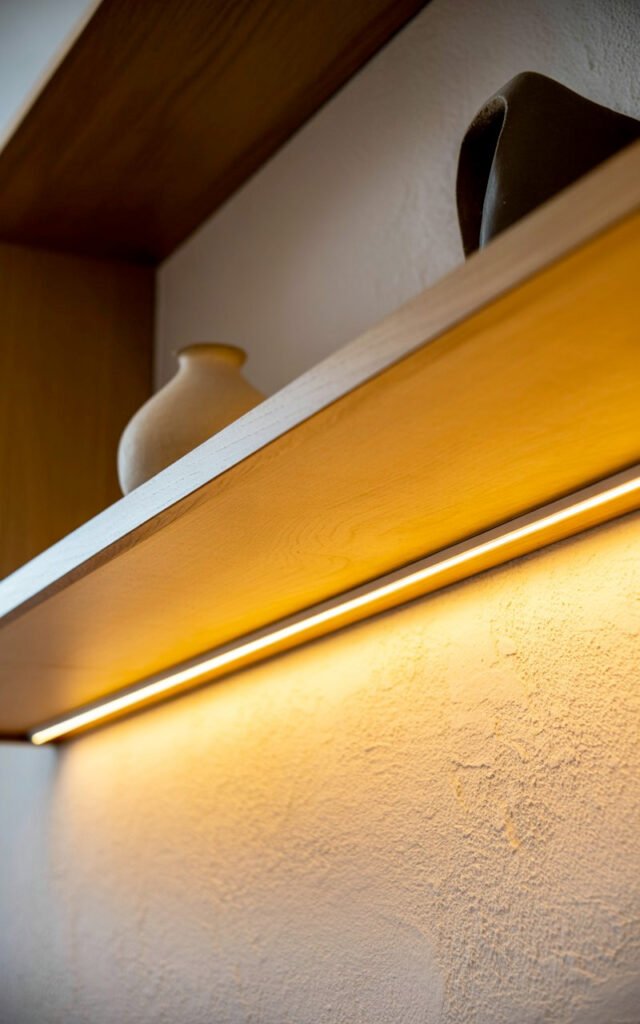
Notice how those shelves in the inspo image have lighting? That’s not just pretty—it’s functional accent lighting that completely transforms the space.
Why Lighting Matters Even More in Small Bedrooms
One harsh overhead light makes small rooms feel like cells: You need layered, warm lighting to create depth and ambiance.
Good lighting adds dimension: Shadows and highlights make spaces feel more interesting and larger.
Task lighting is essential: In small bedrooms, you might not have space for a desk lamp or floor lamp, so built-in lighting becomes critical.
Ambient lighting sets the mood: Your bedroom should feel like a retreat, not an interrogation room.
Types of Accent Lighting for Small Bedrooms
LED strip lights: These are perfect for:
- Under floating shelves (like the inspo image)
- Behind your headboard
- Under your bed frame
- Inside closets
- Around mirrors
They’re cheap, easy to install (most are adhesive-backed), and use minimal electricity.
Puck lights: Small, circular lights that can be:
- Mounted on shelves
- Used in corners for soft ambient light
- Battery-operated or hardwired
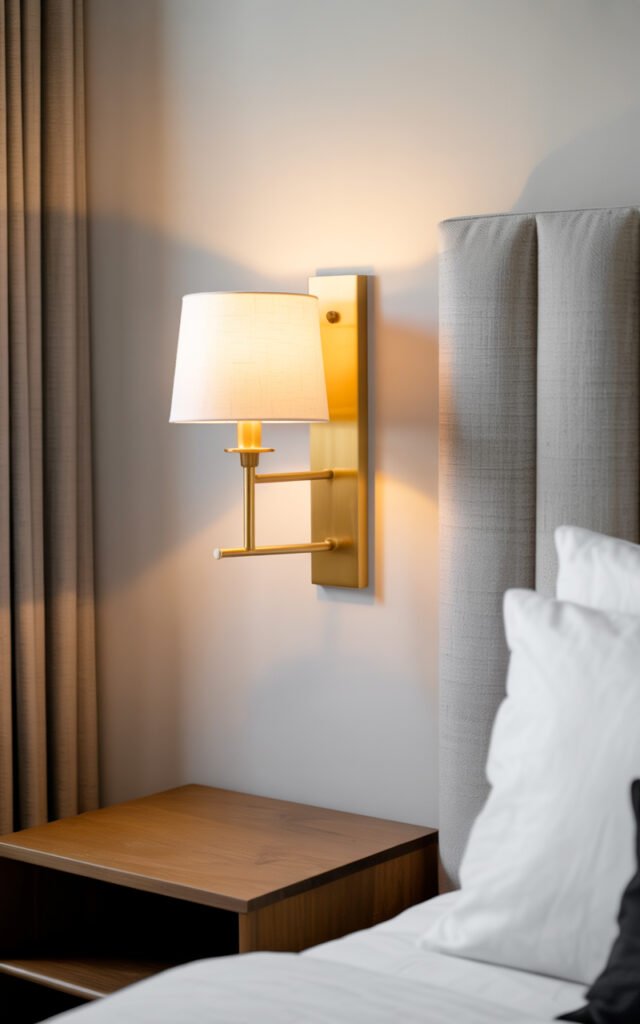
Wall sconces: Save nightstand space while providing reading light. Swing-arm versions are especially practical.
String lights: Yes, they can work in adult bedrooms when done right. Warm white bulbs hung deliberately, not randomly, create cozy ambiance.
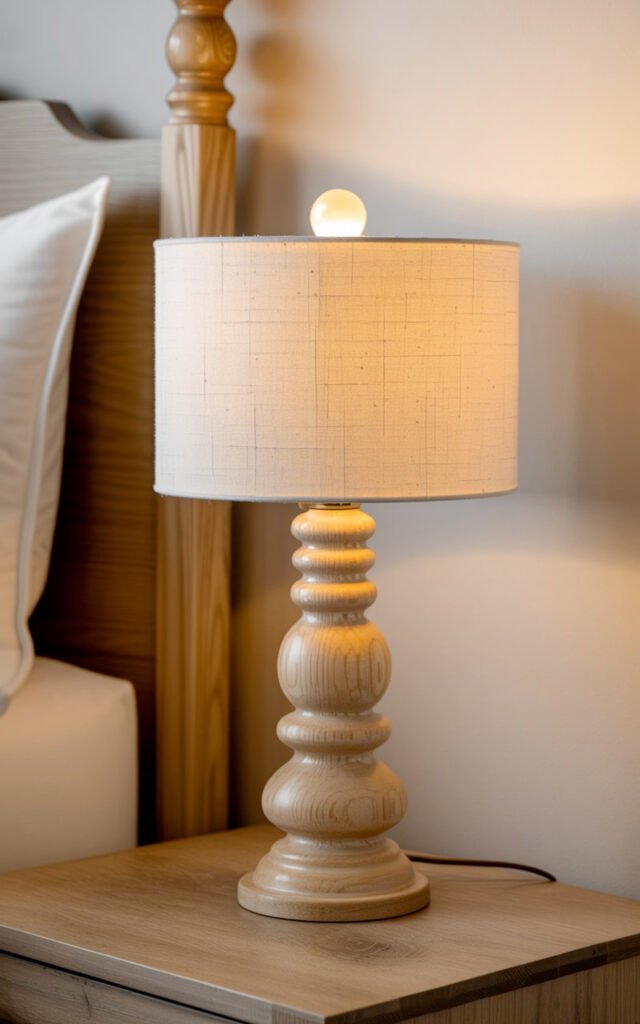
Table lamps: Choose ones with interesting shapes that double as decor. In small spaces, everything needs to be both functional AND beautiful.
I installed LED strip lights under my shelves using adhesive-backed strips I got online for $25. Added a remote dimmer so I can adjust the brightness. It completely changed my room—went from feeling cramped to feeling intentionally cozy.
Installation Tips for Built-In Lighting
Plan your power source: Where’s the nearest outlet? Can you hide cords?
Use warm white bulbs: Cool white feels institutional. Warm white (2700-3000K) feels cozy.
Install dimmers: Being able to adjust your lighting is essential for creating the right mood.
Hide the hardware: Tuck transformers and excess cord behind furniture or in cable channels.
Test before permanently installing: Make sure you like the effect before you commit.
Maximizing Vertical Space in Small Bedrooms
Your walls are underutilized real estate. Let’s fix that.
Floor-to-Ceiling Solutions
Tall bookcases or shelving units: Go as high as your ceiling allows. Yes, you’ll need a step stool for the top shelves. That’s fine—use them for things you don’t access daily.
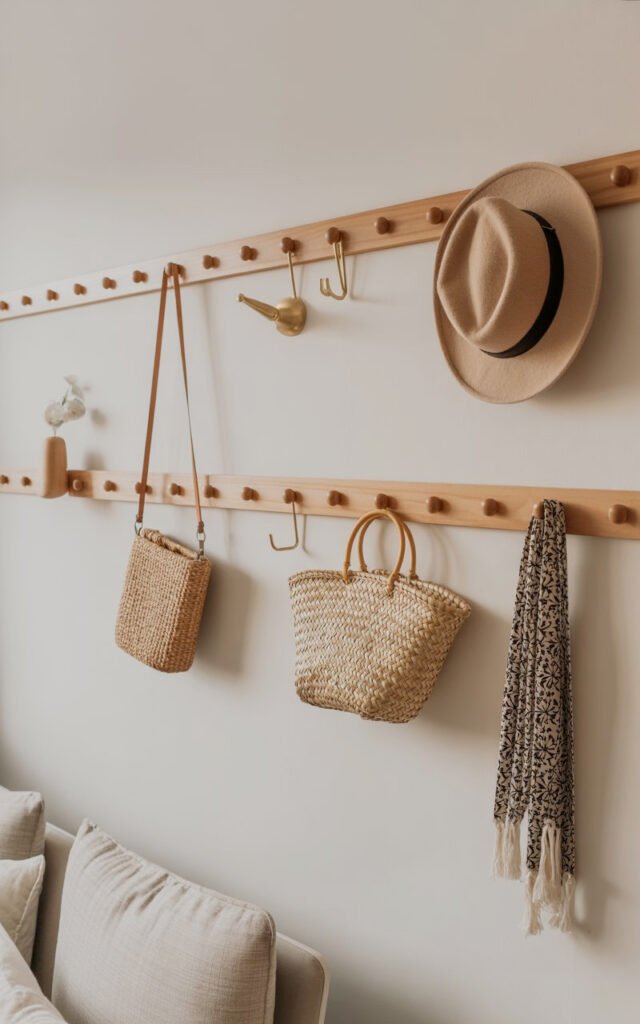
Vertical storage systems: Think pegboards, grid systems, or rail systems where you can hang shelves, hooks, and baskets.
Stacked storage: Built-in or furniture that goes UP rather than OUT.
The Corner Strategy
Corners are where small bedrooms waste the most space. That inspiration image gets it right—corner shelving is brilliant.
Corner floating shelves: We covered these already, but seriously, they’re magic.
Corner desks: If you need a workspace, a corner desk uses space that would otherwise be dead.
Corner seating: A small chair or reading nook in a corner creates functionality without blocking pathways.
Tall corner shelving units: Floor-to-ceiling corner units add tons of storage.
Above-Door Storage
The space above your door? That’s storage space. Install a shelf above your door for:
- Books
- Storage boxes with seasonal items
- Decorative items you don’t need to access often
Furniture Selection for Tiny House Decor Vibes
Choosing furniture for small bedrooms requires ruthless decision-making. Every piece must justify its existence.
The Bed: Your Biggest Space Commitment
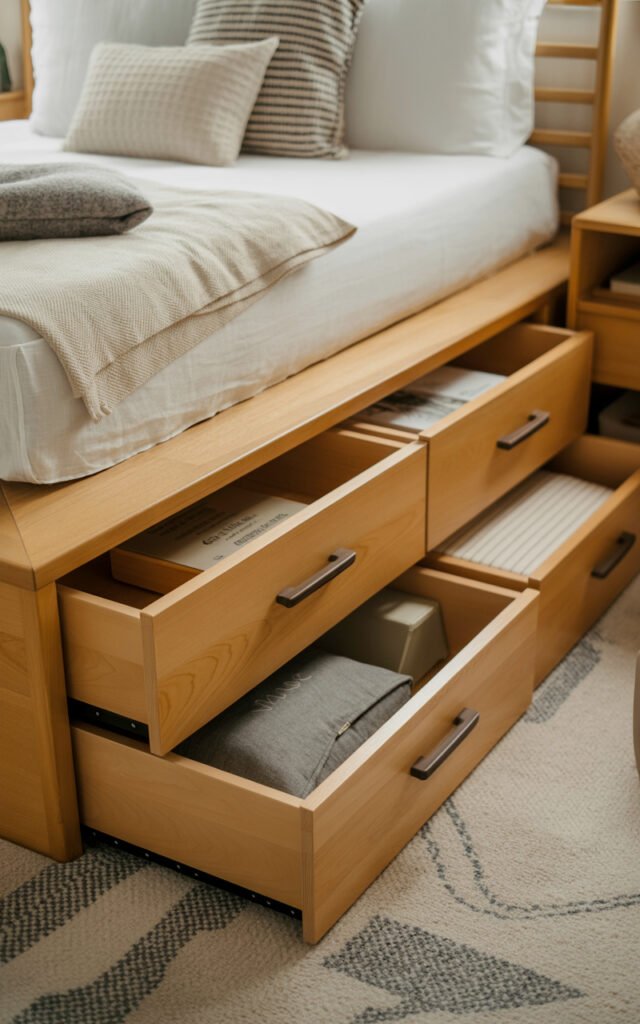
Platform beds with storage: Drawers underneath or lift-up platforms are non-negotiable for small bedrooms. That space under your bed is too valuable to waste.
Murphy beds: If you’re hardcore about maximizing space, a quality Murphy bed (wall bed) can transform a bedroom into a multi-use space.
Loft beds: If you have the ceiling height, putting your bed on a loft creates a whole room underneath for a desk, seating, or storage.
Size considerations: A full bed might make more sense than a queen in a very small room. Measure carefully and consider how much floor space you’ll have left.
I went with a platform bed with four drawers underneath. Those drawers hold all my out-of-season clothes, extra bedding, and things I don’t need daily access to. Absolute game-changer.
Nightstands That Work Harder
Traditional nightstands are often too bulky for small bedrooms. Better options:
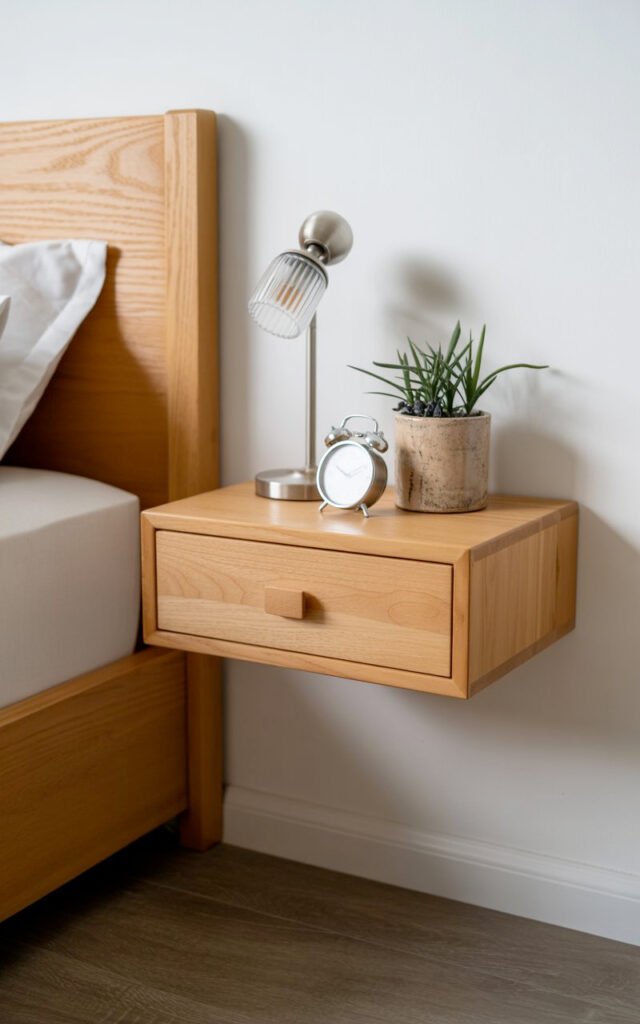
Floating nightstands: Wall-mounted, no floor footprint, looks modern and light.
Small dressers: A narrow 3-drawer dresser can serve as a nightstand while providing actual storage.
Stools or small tables: A simple stool or small accent table takes up minimal space.
Wall-mounted shelves: Just a floating shelf next to your bed with a reading light—sometimes that’s all you need.
Multi-Functional Furniture
Storage ottomans: Seating, footrest, and storage in one.
Fold-down desks: Wall-mounted desks that fold up when not in use.
Bench with storage: At the foot of your bed or against a wall—seating and storage.
What to Skip in Small Bedrooms
- Large armoires (unless they’re literally your only storage)
- Bulky dressers when closet organization can work instead
- Accent chairs that just collect clothes
- Coffee tables or unnecessary side tables
- Anything oversized “because I like it” (I know, it hurts, but space is finite)
Creating a Minimalist Home Aesthetic Without Sacrificing Personality
Minimalist home design doesn’t mean your bedroom has to look like a stark white box with nothing in it. It means intentional choices and quality over quantity.
The Minimalist Approach to Small Bedrooms
Every item earns its place: If it’s not beautiful, functional, or meaningful, it doesn’t belong.
Clear surfaces create calm: Nightstands and dressers shouldn’t be covered in random stuff.
Neutral base, personal accents: Start with a neutral palette and add personality through carefully chosen items.
Hidden storage: The less visible clutter, the more peaceful the space feels.
How to Add Personality Without Clutter
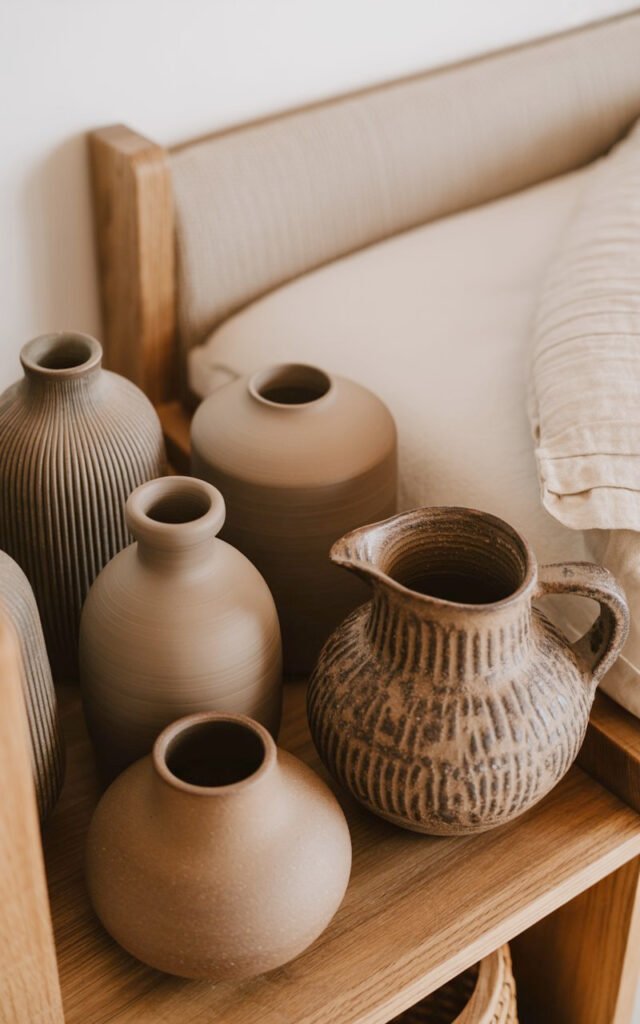
Curated collections: Instead of random tchotchkes everywhere, choose a few meaningful items to display beautifully.
Statement textiles: Your bedding, curtains, and maybe one throw pillow can add color and personality without taking up space.
Wall art: Vertical real estate, remember? A few well-chosen pieces of art add personality without floor space.
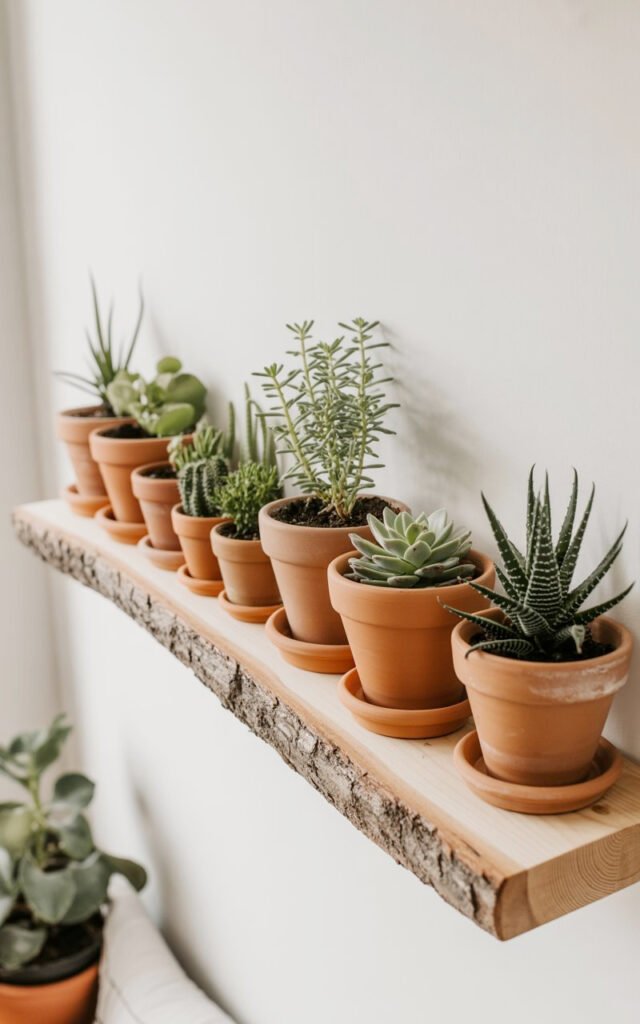
Plants: Living things add life and color without cluttering surfaces if you use wall planters or hanging plants.
One signature piece: Maybe it’s a unique lamp, a vintage chair, or an interesting headboard—one special item that reflects your style.
I have three things that make my minimalist small bedroom feel like mine: a vintage brass lamp I inherited, a gallery wall of black and white photos, and plants on my floating shelves. That’s it. Less is more when space is tight.
Modern Lighting Strategies for Small Spaces
We touched on accent lighting, but let’s dig deeper into overall modern lighting strategy.
The Three-Layer Lighting Approach
Ambient lighting: Your general room lighting
- Overhead fixture (flush-mount or semi-flush for low ceilings)
- Or distributed lighting like multiple wall sconces
- Should be dimmable
Task lighting: For specific activities
- Reading lights by your bed
- Desk lamp if you work in your bedroom
- Closet lighting (seriously, don’t skip this)
Accent lighting: For ambiance and visual interest
- Under-shelf lighting
- LED strips
- Decorative lamps
- Candles
In my small bedroom, I have a flush-mount ceiling light (ambient), wall-mounted reading lights on either side of my bed (task), and LED strips under my shelves (accent). I can adjust the combination based on time of day and mood.
Small Bedroom Lighting Don’ts
Don’t rely on one overhead light: Harsh, unflattering, and makes small rooms feel even smaller.
Don’t use cool white bulbs: They’re terrible for bedrooms. Stick with warm white.
Don’t skip task lighting: You’ll regret it when you’re trying to read or get dressed in weird shadows.
Don’t forget about natural light: We’ll cover window treatments shortly, but maximize any natural light you have.
Lighting Placement for Maximum Impact
Above head height: Lighting above your eyeline makes ceilings feel higher.
In corners: Lights in corners eliminate dark spots that make rooms feel smaller.
Behind furniture: Lighting behind headboards or dressers creates depth.
Under elements: Under-shelf, under-bed, or under-cabinet lighting adds dimension.
Color Palette Strategies for Small Bedrooms
Color choices can make or break a small bedroom. Here’s what actually works.
Light and Neutral Base
Light colors reflect light and make spaces feel larger. That’s just physics.
Best base colors:
- Warm white or cream
- Light gray (warm-toned, not cool)
- Soft beige or greige
- Pale sage or blue-gray (if you want subtle color)
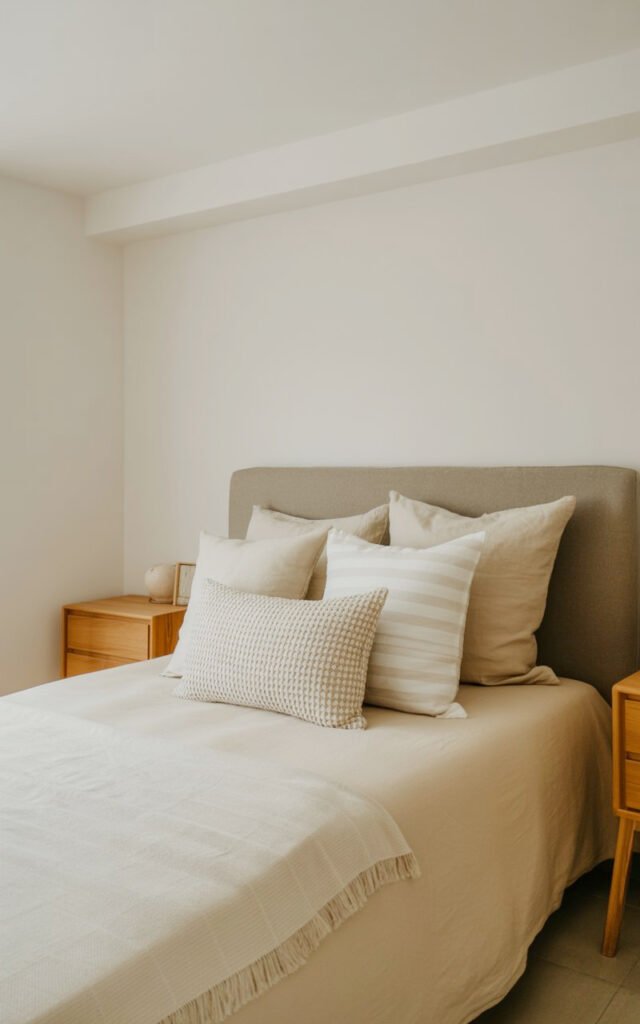
Paint your walls, ceiling, and even trim in similar light tones to eliminate visual boundaries that make rooms feel choppy and smaller.
Adding Depth Without Darkness
You can use darker colors in small bedrooms, but strategically:
Accent wall: One wall in a deeper tone while keeping others light.
Lower half: Paint the bottom half of walls darker with light on top (not for everyone, but can work).
Ceiling: A slightly darker ceiling can make a room feel cozier without shrinking it (controversial, but it works sometimes).
Where to Add Color
Instead of painting walls dark, add color through:
- Bedding and textiles
- Artwork
- Plants
- Decorative objects
- One piece of furniture
This way you get personality and color without the commitment or space-shrinking effect.
Window Treatments That Don’t Overwhelm
In small bedrooms, window treatments need to be functional without being bulky or dark.
Best Options for Small Bedrooms
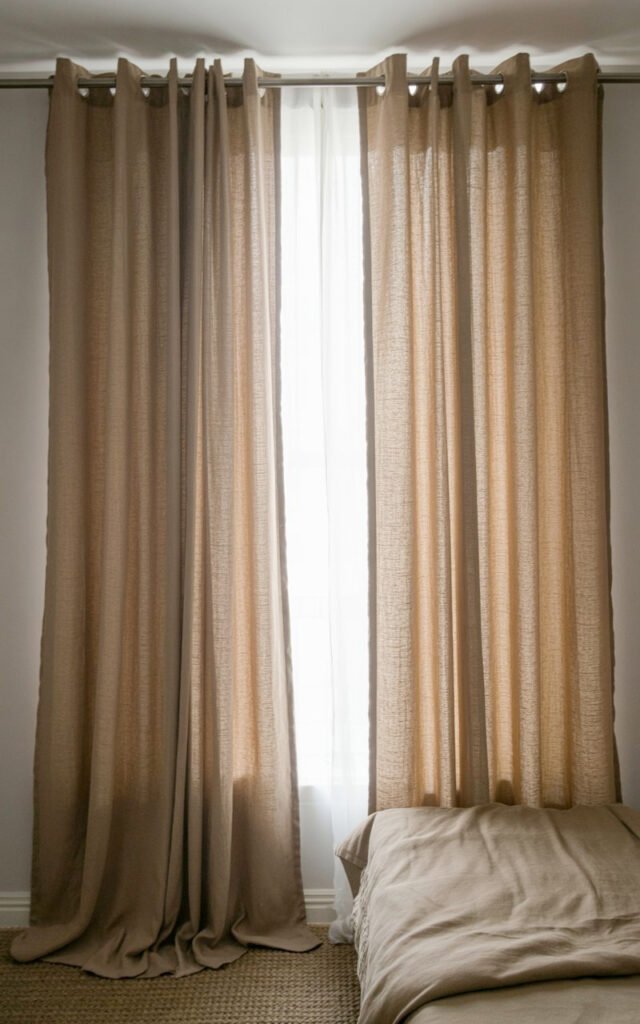
Simple curtains: Light-colored, floor-to-ceiling curtains in lightweight fabrics. Hang them high and wide to make windows appear larger.
Roman shades: Clean, flat when raised, and come in various fabrics and light-filtering options.
Roller shades: Minimalist, functional, and take up virtually no space.
Cellular shades: Great for insulation and light control, and they’re slim.
Sheer panels: If privacy isn’t an issue, sheers maximize natural light while adding softness.
What to Avoid
Heavy, dark curtains: Make small rooms feel cave-like.
Valances and swags: Too fussy and old-fashioned for modern small bedrooms.
Curtains that puddle on the floor: Waste of fabric and visually heavy.
Busy patterns: Keep it simple in small spaces.
I have simple white linen curtains hung just below the ceiling molding, extending several inches beyond my window on each side. They make my small window look much larger and the whole room feel brighter.
Storage Solutions That Don’t Look Like Storage
The key to a beautiful small bedroom is hiding the necessary storage.
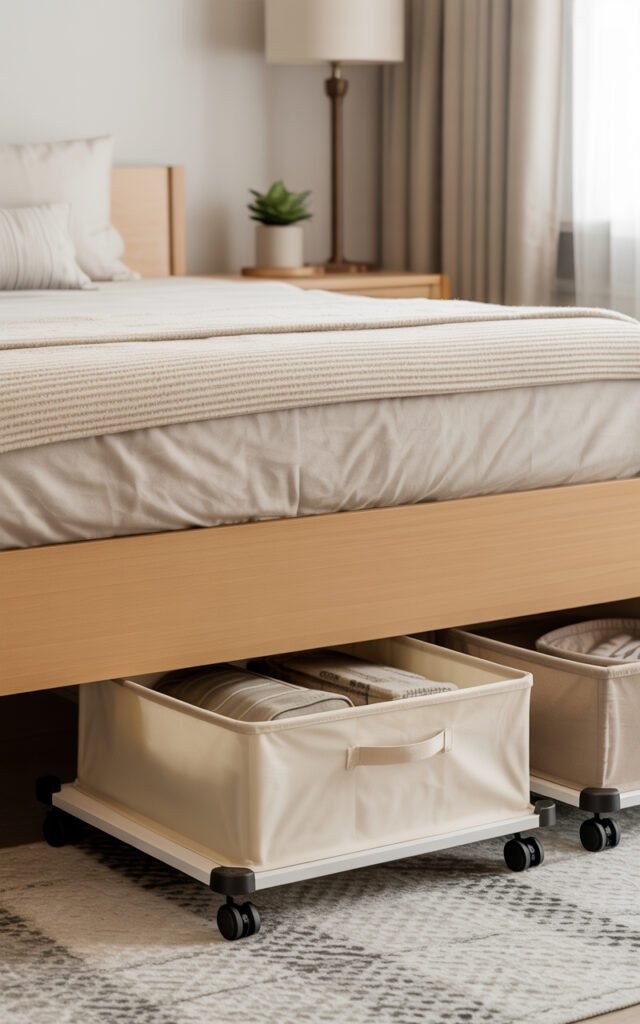
Under-Bed Storage
We mentioned this, but it bears repeating—use that space:
- Rolling drawers
- Flat storage bins
- Custom-built drawers in your platform bed
- Vacuum-sealed bags for out-of-season items (but keep it organized)
Vertical Storage Systems
Wall-mounted organizers: Hooks, rails, and pegboards for items you use regularly.
Over-door organizers: For shoes, accessories, or small items.
Hanging organizers: In closets for accessories, shoes, or folded items.
Hidden Storage Furniture
Ottoman with storage: Toss in blankets, pillows, or out-of-season items.
Bed frame with drawers: Maximizes that under-bed real estate.
Hollow furniture: Benches, nightstands, or footstools with storage inside.
Closet Maximization
Your closet might be small, but it can work harder:
- Double hanging rods (short items over short items)
- Shelf dividers to stack items vertically
- Hanging organizers for shoes or accessories
- Vacuum bags for bulky items like winter coats
- Drawer units that fit on the closet floor
I installed a closet organization system with double rods and shelves above. Probably doubled my closet’s capacity for about $100 in materials.
Dream House Touches in Small Bedrooms
Just because your bedroom is small doesn’t mean it can’t have those dream house elements you crave.
Luxury Elements That Work in Small Spaces
Quality bedding: High thread count sheets, a real duvet, good pillows—these don’t require extra space, just investment.
Statement lighting: That gorgeous lamp or light fixture you love can absolutely work.
Interesting textures: Velvet, linen, chunky knits, faux fur—texture adds luxury without taking up space.
Art: Beautiful artwork makes any space feel more intentional and special.
Fresh flowers or quality faux plants: This small touch elevates everything.
Creating a Spa-Like Atmosphere
Scent: A signature candle or diffuser makes your room feel like a retreat.
Sound: White noise machine or quality speaker for music.
Comfort: The best mattress you can afford, quality pillows, soft rugs.
Organization: Clutter-free spaces feel luxurious.
Log Home Interiors Influence in Modern Bedrooms
Those log home interiors vibes—warm woods, natural materials, cozy atmosphere? You can absolutely incorporate that into small bedroom design.
Bringing in Natural Wood Elements
Floating shelves in natural wood: Like the inspiration image—warm wood shelves add organic warmth.
Wood bed frame: Light or medium-toned wood feels warm and natural without heaviness.
Wood accents: Picture frames, decorative objects, small furniture pieces.
Wood-look accessories: Lamps, mirrors, or organizational items.
Balancing Wood with Modern Elements
Too much wood can feel heavy in small spaces. Balance it:
- White or light walls
- Mixed materials (wood + metal, wood + ceramic)
- Clean lines in furniture
- Modern lighting to offset rustic wood tones
My natural wood floating shelves against white walls create that warm-but-fresh vibe that feels both cozy and spacious.
Small Bedroom Layout Strategies
How you arrange furniture matters enormously in small bedrooms.
The Bed Placement Dilemma
Against the wall: Maximizes floor space but makes one side less accessible. Fine for solo sleepers.
Centered on main wall: Traditional and balanced but uses more floor space.
In a corner: For very small rooms, this might be your only option.
Under a window: Not ideal (blocks light, creates furniture arrangement challenges) but sometimes necessary.
Creating Traffic Flow
You need at least 24 inches of walking space around your bed and to your closet/door. Measure before you buy or move anything.
Avoid creating obstacle courses: Every piece of furniture should have a clear purpose and placement that doesn’t block pathways.
Keep the path to bed clear: You’ll be walking this path daily, half-asleep—don’t make it complicated.
Functional Zones in Small Bedrooms
Even small bedrooms can have zones:
- Sleeping zone: The bed and immediate area
- Dressing zone: By your closet or mirror
- Reading/relaxing zone: A corner with a chair or floor pillows
- Storage zone: Where your storage lives (under bed, shelves, closet)
These don’t need to be separate areas—they can overlap, but thinking in zones helps with organization.
Common Small Bedroom Mistakes (And How to Fix Them)
Let me save you from errors I’ve made or seen:
Mistake #1: Oversized Furniture
That queen bed might fit technically, but if you can barely walk around it, your room feels like a storage unit, not a bedroom.
Fix: Choose furniture proportional to your space. Sometimes a full bed makes more sense than a queen.
Mistake #2: Ignoring Vertical Space
Leaving walls bare while complaining about no storage space is like standing in the rain complaining about being thirsty.
Fix: Look up. Install shelves, use wall hooks, mount things.
Mistake #3: Too Many Small Items Everywhere
Lots of tiny decorative objects create visual clutter that makes small spaces feel chaotic.
Fix: Fewer, larger items have more impact. Group small items together rather than scattering them.
Mistake #4: Poor Lighting
One overhead light is depressing and unflattering.
Fix: Layer your lighting. Add bedside lights, accent lighting, and dimmers.
Mistake #5: Dark, Heavy Window Treatments
Making your only window feel smaller and darker is a bad choice.
Fix: Light, simple window treatments that maximize light while providing privacy.
Mistake #6: Ignoring the Door Swing
Furniture placement that interferes with your door opening fully is frustrating daily.
Fix: Map out your door swing when planning furniture placement.
Mistake #7: Keeping Everything Because “It Might Fit”
Cramming everything you own into a small bedroom makes it feel even smaller.
Fix: Edit ruthlessly. If you don’t use it or love it, find it a new home.
Budget Breakdown: Creating a Stylish Small Bedroom
Here’s how to allocate a $800 budget:
Paint and supplies: $50
- Light neutral paint
- Primer if needed
- Brushes and rollers
Floating shelves with lighting: $150
- 3-4 floating shelves
- LED strip lights with dimmer
- Brackets and hardware
Bed frame with storage: $250
- Platform bed with drawers or DIY storage solution
- This is a big-impact item worth prioritizing
Bedding: $120
- Quality sheets
- Duvet or comforter
- 2-3 pillows with covers
Lighting: $100
- 2 bedside lights or wall sconces
- Warm bulbs
- Maybe a floor lamp if space allows
Storage solutions: $80
- Under-bed storage containers
- Closet organization items
- Baskets or bins for shelves
Decor and accessories: $50
- Plants and planters
- Small decorative objects
- Candle or diffuser
Total: $800
You can absolutely do this for less by shopping secondhand, DIYing more elements, or being patient with purchases.
Maintaining Your Small Bedroom
A small bedroom requires more maintenance discipline than a large one because clutter accumulates faster.
Daily Habits
- Make your bed (it’s literally 40% of your visible space)
- Put clothes away immediately (don’t let the chair become a clothes pile)
- Clear surfaces before bed
- Quick 2-minute tidy before leaving in the morning
Weekly Tasks
- Dust shelves and surfaces
- Vacuum or sweep floors
- Wash bedding
- Assess clutter and remove anything that doesn’t belong
Monthly Reviews
- Evaluate what’s working and what isn’t
- Purge items you’re not using
- Reorganize as needed
- Deep clean including under bed and on high shelves
Seasonal Rotations
- Swap out seasonal clothing
- Rotate decor if desired
- Deep clean everything
- Reassess storage solutions
Making Peace with Small Space Living
Here’s the mindset shift that changed everything for me: A small bedroom isn’t a compromise—it’s an opportunity to be intentional and create a space that’s perfectly tailored to you.
Some benefits of small bedrooms people don’t talk about:
Easier to keep clean: Less space = less to maintain.
Cozier by nature: Small spaces feel intimate and comfortable.
Forces minimalism: You can’t keep things “just because”—everything must earn its place.
Less expensive to furnish and decorate: You need less stuff.
Easier to heat and cool: Lower energy costs.
Encourages creativity: Limited space inspires creative solutions.
Your small bedroom can be just as beautiful, functional, and comfortable as a large one. Sometimes more so, because every decision is intentional and every element serves a purpose.
Final Thoughts: Your Small Bedroom, Perfected
Creating a beautiful small bedroom isn’t about tricks to make it look bigger (though those help). It’s about maximizing every inch, making smart choices, and creating a space that serves your needs without unnecessary excess.
Start with the big impact changes—paint, shelving, lighting. Then layer in the details that make it yours. Take your time finding the right pieces rather than filling your space with things that are just “okay.”
Remember those floating shelves with built-in lighting we talked about? That one upgrade changed my entire bedroom. It added storage, style, and ambiance—everything a small bedroom needs to feel complete.
Your small bedroom has potential you haven’t tapped into yet. The corners you’re not using, the walls that could hold shelves, the lighting that could transform the entire mood, the storage hiding under your bed. It’s all there, waiting for you to reimagine it.
Now go make your small bedroom so functional and beautiful that you actually want to hang out there. Because small spaces done right? They’re the best spaces of all. 🙂