Long hallways are basically the middle child of home design – nobody pays attention to them until suddenly you realize you’ve been walking through a beige tunnel for years and it’s kind of depressing.
I get it. When you’re on a budget, hallways feel like the last priority. But here’s the thing: they’re actually one of the easiest spaces to make impressive without spending a fortune. You’ve got four walls and a ceiling – that’s it. No furniture shopping, no major construction, just smart design choices.
Let me show you how to turn that forgettable corridor into something people actually notice.
Why Long Hallways Feel Like A Problem
The issue with big hall decoration isn’t usually the length – it’s that long hallways often feel like tunnels. Narrow, repetitive, with nothing to break up the monotony as you walk through.
Common long hallway challenges:
- They feel like dead space, not part of the home
- The length emphasizes the narrowness
- They’re usually poorly lit
- Doors interrupt any decorating flow
- Hard to find the right scale for art or decor
But every single one of these has a solution that doesn’t require knocking down walls or spending thousands.
Floral Hallway Decor: The Wallpaper Approach
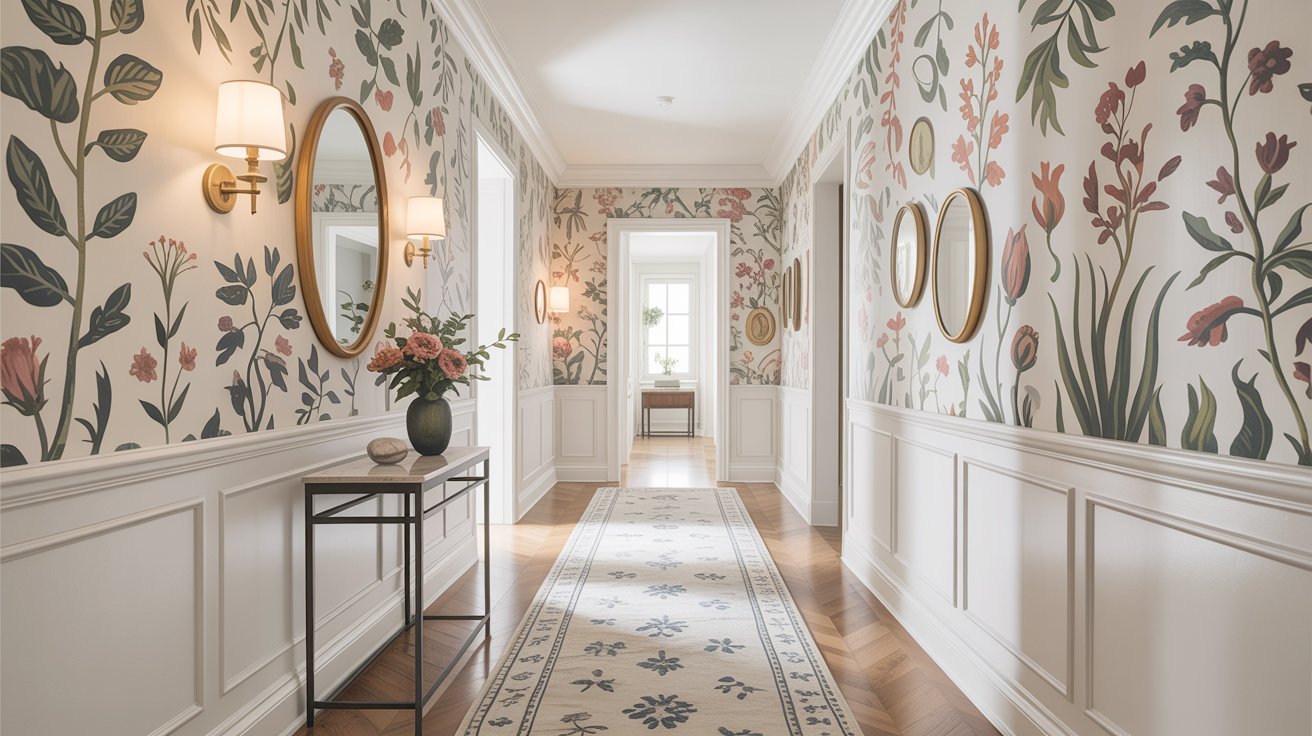
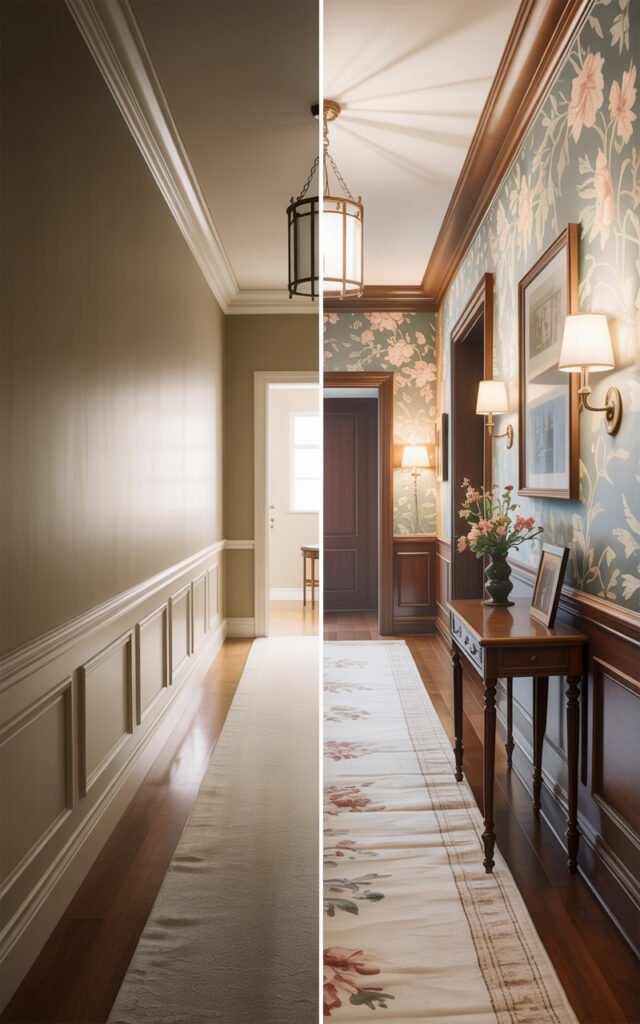
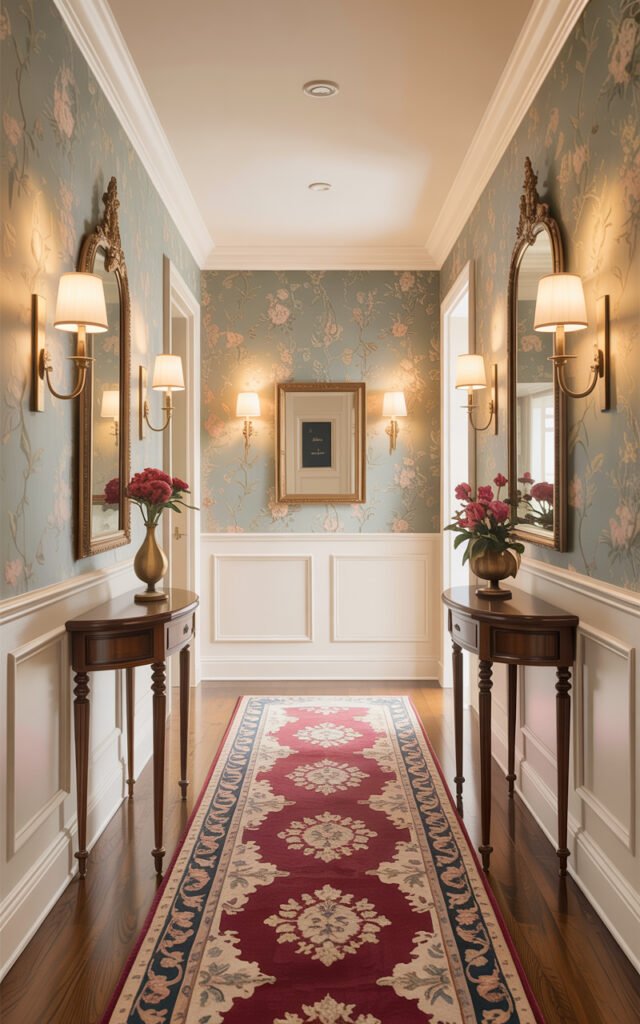
Can we talk about that wallpaper in the image? Because it’s honestly the star of the show. Floral hallway decor via wallpaper is one of those moves that immediately elevates a space from “basic builder-grade” to “did you hire a designer?”
Why wallpaper works in long hallways:
- Creates visual interest without taking up space
- Draws the eye up and along (not just down the tunnel)
- One pattern can unify the entire length
- Makes the space feel intentional and designed
- Way more affordable than you’d think
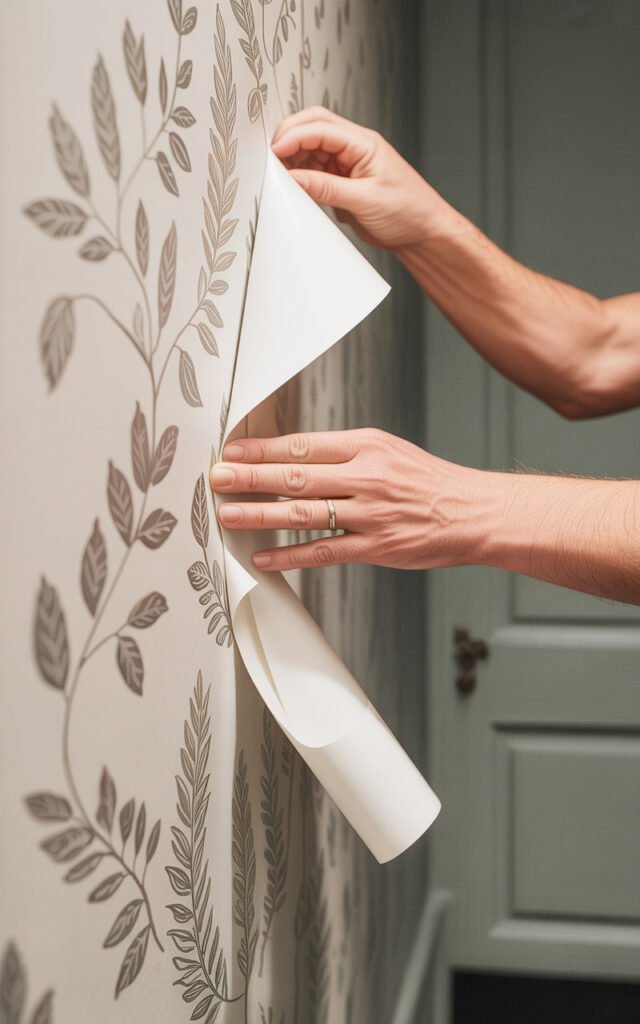
I was intimidated by wallpaper for years (seemed expensive and permanent), but peel-and-stick options have changed the game completely. You can do a whole hallway for $200-400 and remove it when you move or get bored.
Choosing The Right Pattern
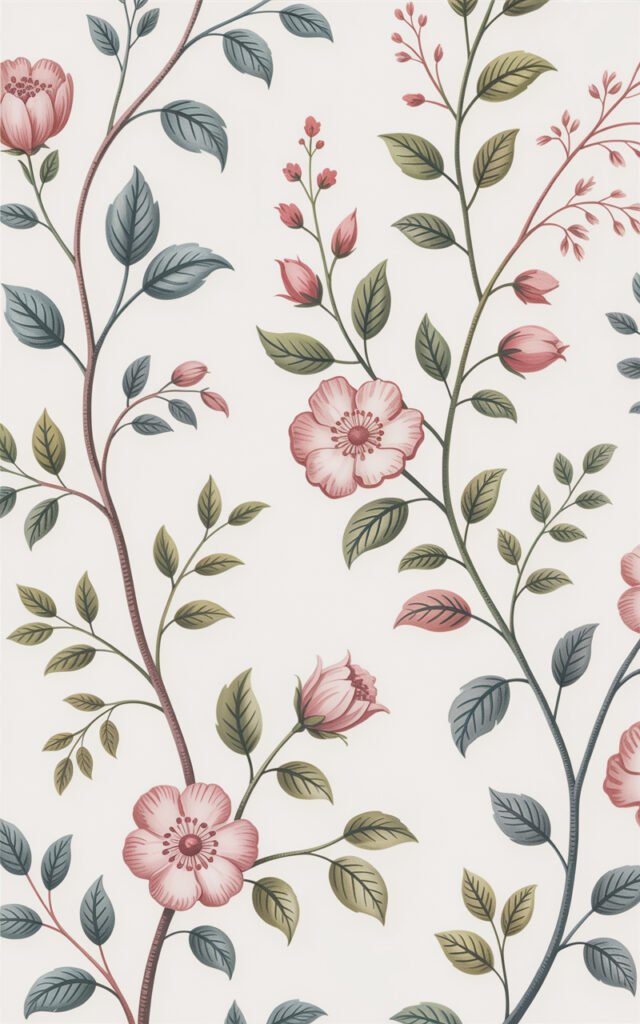
Not all wallpaper works in narrow spaces. The pattern in the image is perfect – delicate botanical branches on a light background. It’s detailed enough to be interesting but airy enough not to overwhelm.
Patterns that work in long hallways:
- Vertical designs that draw the eye up
- Delicate florals or botanicals (like in the image)
- Subtle textures or grasscloth
- Thin stripes (vertical, not horizontal)
- Mural-style scenes that create depth
Patterns to avoid:
- Large-scale busy prints (too overwhelming)
- Dark, heavy patterns (make it feel closed in)
- Horizontal stripes (emphasize the tunnel effect)
- Super bold colors (claustrophobic in narrow spaces)
I went with a subtle botanical wallpaper similar to the image (got it on sale at Wayfair for $180 for my 25-foot hallway), and the difference was immediate. Suddenly my hallway felt like a gallery space instead of a passage nobody noticed.
Hallway Millwork Ideas: The Wainscoting Game-Changer
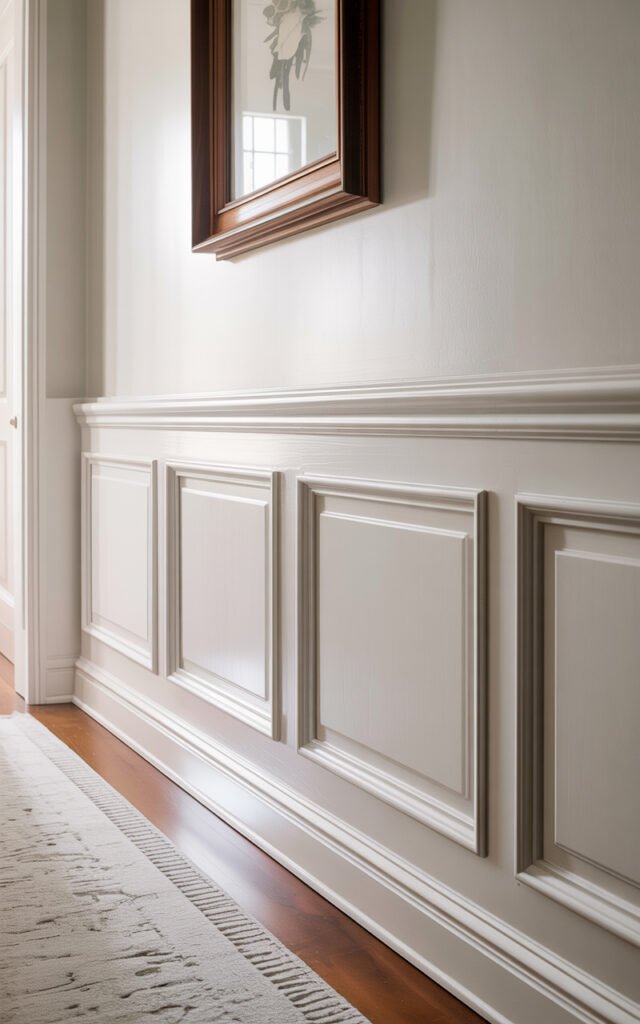
Look at that lower wall treatment in the image – that’s wainscoting or picture frame molding, and it’s one of the best investments you can make in a long hallway.
Why millwork matters:
- Adds architectural interest to plain walls
- Creates visual breaks in a long space
- Makes the hallway feel more expensive
- Protects walls from scuffs and damage
- Works with any style (traditional to modern)
Real wood wainscoting can be pricey, but here’s the budget secret: you can create the same look with MDF boards and paint for a fraction of the cost.
DIY Wainscoting On A Budget
I did this in my hallway for under $150 in materials. Bought 1×4 MDF boards from Home Depot, cut them to size, attached them to the wall with construction adhesive and finishing nails, filled the seams, and painted.
Materials needed:
- MDF boards (1×4 or 1×6)
- Construction adhesive
- Finishing nails
- Wood filler
- Paint (semi-gloss for durability)
- Measuring tape and level
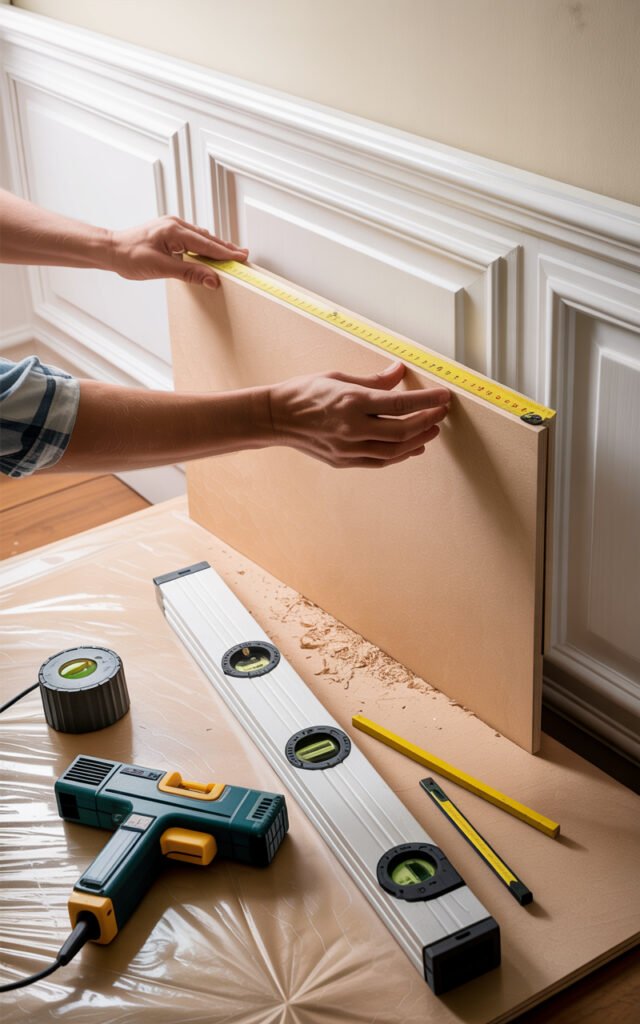
Total time: one weekend. Total cost: about $150 for a 20-foot hallway. The impact? People think you spent thousands.
Chic Hallway Decor: Styling The Space
Once you’ve got your walls sorted (wallpaper, paint, millwork, whatever you choose), you need to style the space so it doesn’t feel empty.
Essential chic hallway elements:
- Console tables at intervals (breaks up the length)
- Mirrors (bounce light and create dimension)
- Wall sconces or interesting lighting
- One or two statement art pieces
- A runner rug (defines the path)
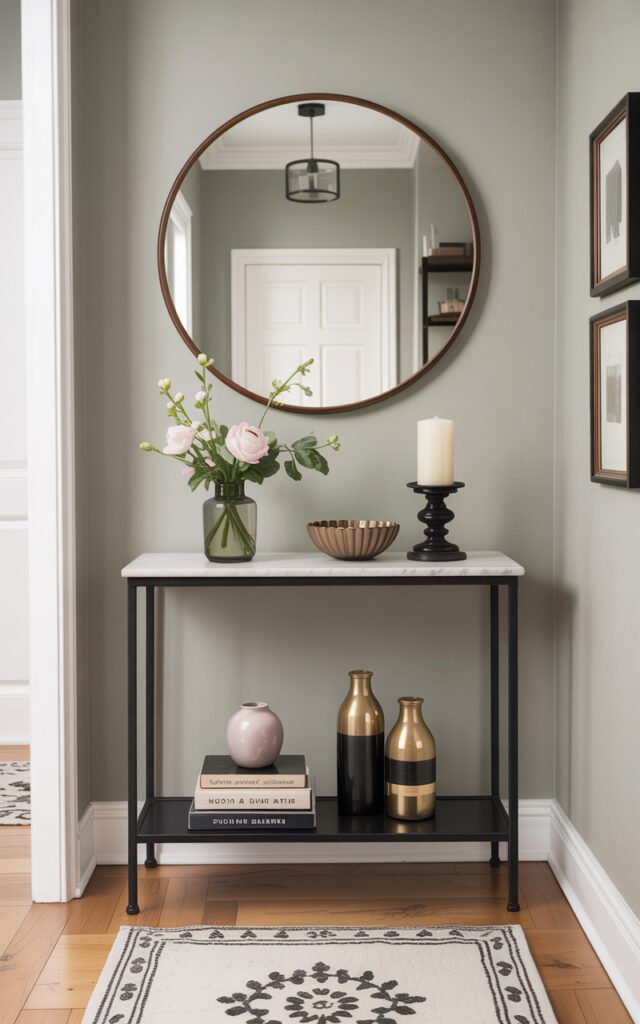
That slim console table in the image is perfect – narrow enough not to block the path but substantial enough to anchor the wall and provide a styling surface.
Console Table Placement
In a long hallway, you might have room for multiple console tables or just one. Either way, placement matters.
For one console: Put it about 1/3 of the way down the hallway, not dead center. It creates a visual stop without feeling too symmetrical.
For multiple consoles: Space them out asymmetrically. Maybe one on the left 1/3 of the way down, another on the right 2/3 of the way. Breaks up the repetition.
I’ve got two slim consoles in my 25-foot hallway – one near the entrance, one toward the middle. Cost me $70 each on sale at Target, and they make the hallway feel furnished without cluttered.
Hall Wall Ideas: What To Do With All That Wall Space
Long hallways = lots of wall space = lots of opportunity to do something interesting.
Gallery wall approach: Multiple frames in different sizes creating a collected look. Works best if your hallway is simple (plain paint, no busy wallpaper).
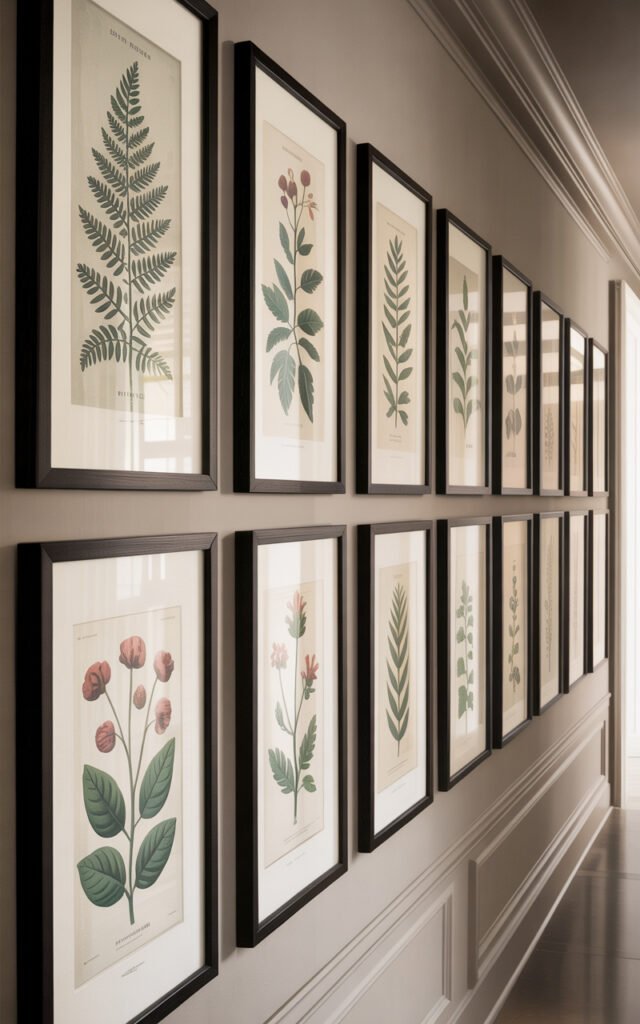
Large-scale art: One or two big pieces instead of many small ones. Makes a statement without overwhelming.
Mirror wall: Multiple mirrors in interesting shapes creating light and dimension.
Mix it up: Mirrors, art, maybe a wall-mounted plant shelf. Variety keeps it interesting over the length.
I went with three large botanical prints (printed at Costco for $20 each, framed in simple black frames from IKEA for $15 each). Total cost: $105 for three substantial pieces that look way more expensive.
Height Matters
Hang art and mirrors at proper gallery height – center at 57-60 inches from the floor. In hallways with high ceilings, you might go slightly higher, but not too high or it looks disconnected from the space.
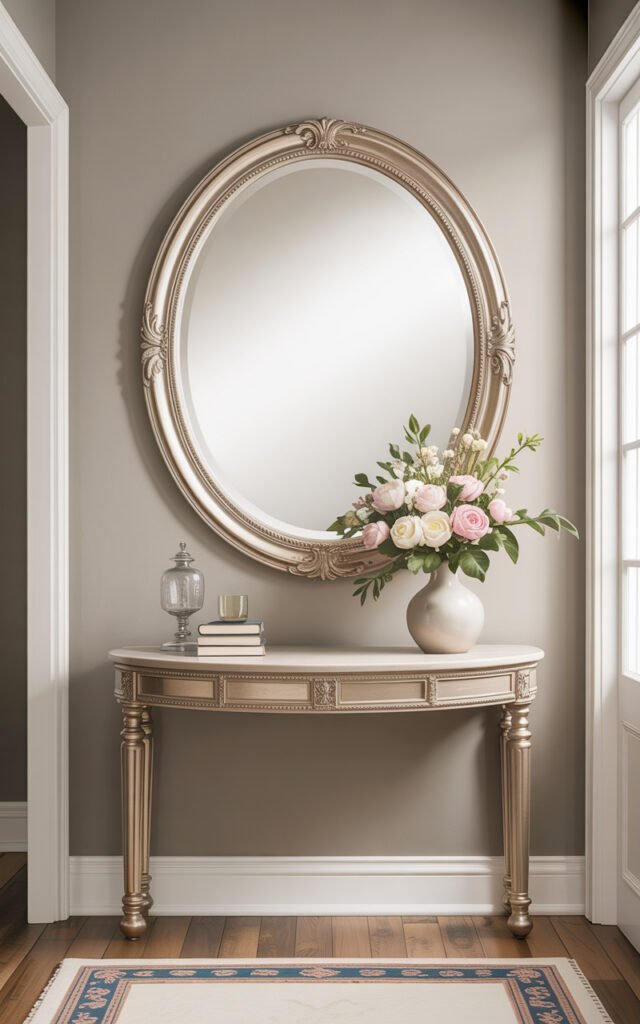
The oval mirror in the image is perfectly positioned – high enough to reflect the beautiful ceiling and wallpaper, but not so high it’s useless for actually looking at yourself.
High Ceiling Hallway Decor: Working With Height
If you’ve got high ceiling hallway decor opportunities like in the image, use that height to your advantage.
Ways to emphasize height:
- Wallpaper that goes all the way up
- Tall mirrors or vertical art
- Sconces mounted higher than standard
- Pendant lights instead of flush mounts
- Crown molding that draws the eye up
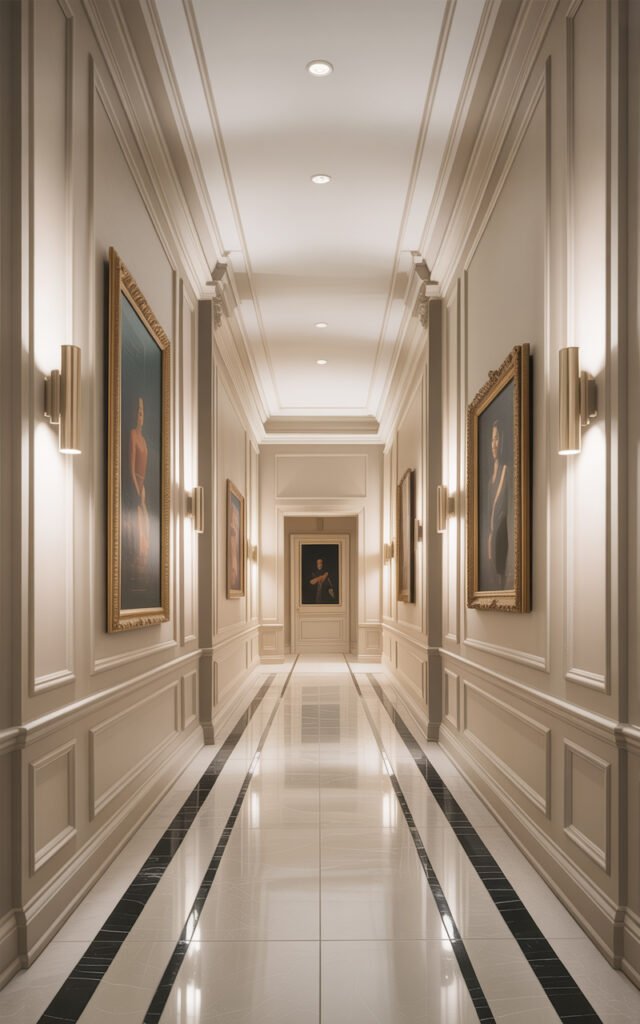
High ceilings in hallways can actually make them feel less tunnel-like because there’s this sense of openness overhead even if the width is narrow.
I don’t have high ceilings in my hallway (standard 8 feet, unfortunately), but I’ve seen friends with 10-12 foot hallway ceilings, and when they use vertical design elements, it’s stunning. The height becomes an asset instead of just empty space.
Ceiling Wallpaper Hallway: The Unexpected Detail
Want to know a secret that’ll blow people’s minds? Ceiling wallpaper hallway treatments.
Most people never think to do anything with the ceiling, but in a long hallway, it’s this massive expanse of usually-boring white. Adding wallpaper (or even just paint) to the ceiling creates this unexpected sophistication.
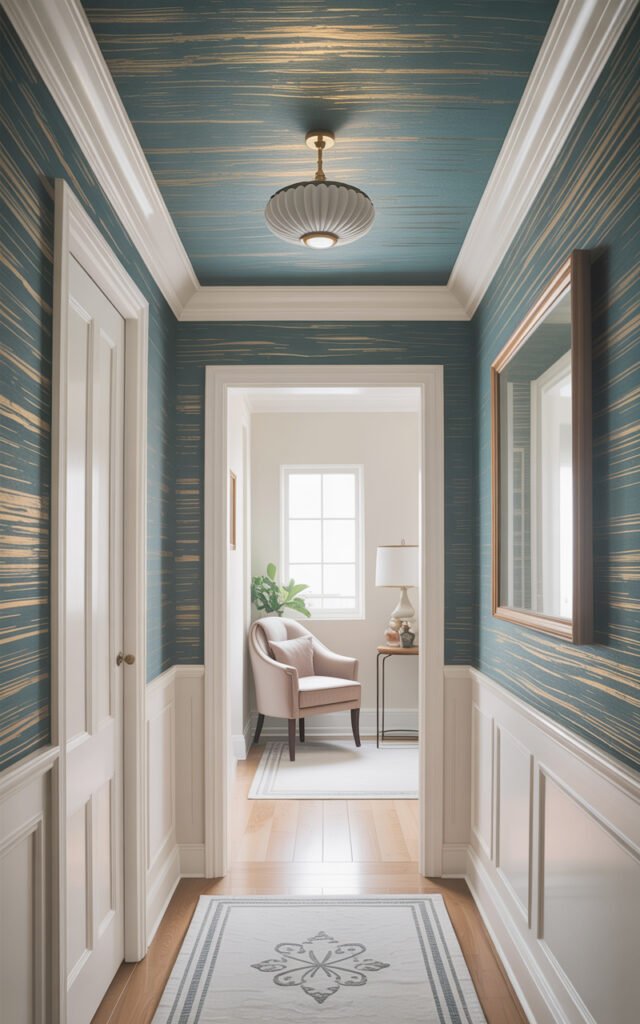
Ceiling wallpaper benefits:
- Completely unexpected (nobody does this)
- Draws the eye up (makes the space feel bigger)
- Unifies the space from above
- Creates a jewel-box effect in a narrow space
- Not that much more expensive (ceilings are smaller than walls)
I haven’t done this yet, but it’s on my list. I saw it in a friend’s townhouse hallway – she used a subtle metallic grasscloth on the ceiling – and it was genuinely stunning. Cost her about $120 in wallpaper and took an afternoon to install.
Easier Than You Think
If you’re using peel-and-stick wallpaper, ceiling installation isn’t much harder than walls. You need a helper to hold one end while you work, but the actual process is the same.
Alternatively, you could just paint the ceiling an interesting color. Even that simple change makes people look up and notice instead of just walking through on autopilot.
Corridor Wall Decor: Breaking Up The Length
Corridor wall decor is all about creating visual stops so the hallway doesn’t feel like it goes on forever.
Ways to break up a long hallway:
- Console tables with lamps (create pools of light)
- Different wall treatments in sections
- A chair or small bench midway through
- Changes in runner rug pattern
- Architectural details like arches or columns (if you’re lucky enough to have them)
In the image, there are multiple consoles with mirrors, wall sconces, and that amazing wallpaper – all working together to make the length feel like multiple intentional moments rather than one endless corridor.
I created breaks in my hallway by painting the first 6 feet a slightly different shade (same color family, just one shade darker), then having the wallpaper section, then back to the lighter shade. Subtle but effective.
Lighting: The Make-Or-Break Element
You can have the best wallpaper and millwork in the world, but if your lighting sucks, the hallway will still feel bad.
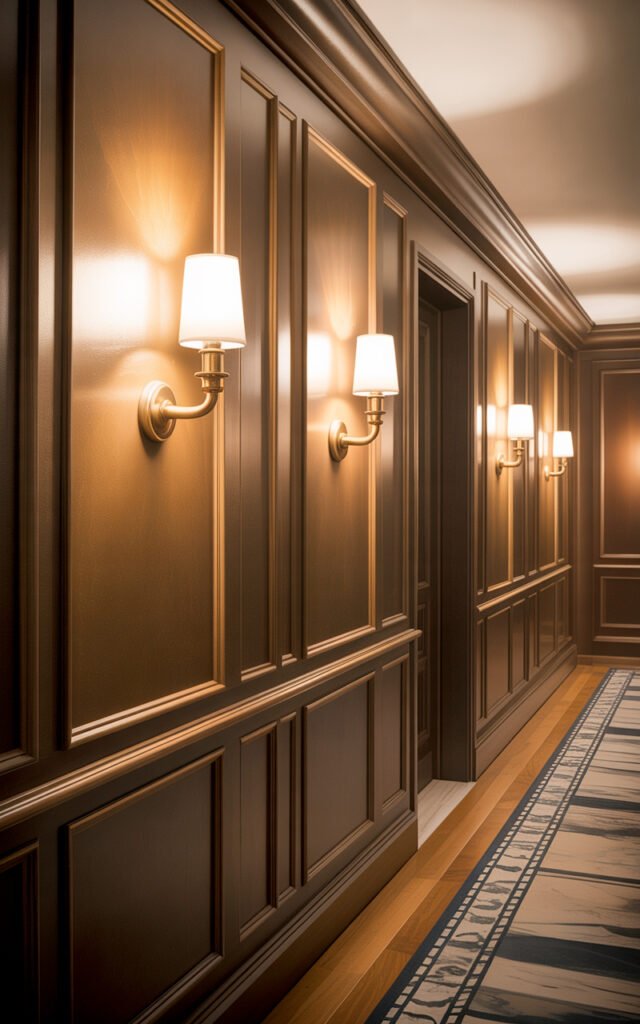
Lighting strategies for long hallways:
- Multiple light sources (not just one overhead fixture)
- Wall sconces every 6-8 feet
- Recessed lighting spaced evenly
- Table lamps on consoles for warm ambient light
- Pendant lights if ceiling height allows
Those gorgeous wall sconces in the image? They’re doing heavy lifting. They create rhythm along the hallway, provide warm light at eye level, and look expensive (but you can find similar styles for $50-100 each at places like Wayfair or Lamps Plus).
Warm Vs. Cool Light
This matters SO much. Cool white bulbs (4000K+) in hallways feel institutional and harsh. Warm white (2700-3000K) feels inviting and cozy.
I switched all my hallway bulbs to 2700K warm white, and combined with my wallpaper and sconces, it went from “hospital corridor” to “boutique hotel.” Same space, just better bulbs.
Hallway Design Interior: Cohesive Style
Your hallway design interior should feel connected to the rest of your home, not like a separate random space.
Creating cohesion:
- Use colors that echo nearby rooms
- Match hardware finishes to other spaces
- Continue flooring or use a complementary style
- Keep the design style consistent with your home’s overall aesthetic
- Use similar lighting styles to other areas
The hallway in the image feels cohesive because the traditional millwork, elegant sconces, and classic wallpaper all speak the same design language. Everything belongs together.
My hallway connects my living room (modern casual) to my bedroom (more traditional), so I split the difference with transitional style – classic wainscoting but modern simple frames for art. It bridges both spaces nicely.
Budget Breakdown: What This Actually Costs
Because I’m not going to pretend you can do this for $50, but you definitely don’t need thousands either.
Minimal budget ($200-400):
- Peel-and-stick wallpaper or DIY millwork
- One or two budget-friendly sconces
- Runner rug from RugsUSA or Wayfair
- DIY art or affordable prints
- Basic console table on sale
Mid-range budget ($400-800):
- Higher quality wallpaper
- Multiple wall sconces
- Better runner rug
- Mix of mirrors and art
- Two console tables
- Professional-looking picture frames
Higher-end budget ($800-1,500):
- Designer wallpaper
- Quality hardwired sconces
- Custom or high-end runner
- Original art or expensive prints
- Multiple styling elements
- Possibly professional installation
I’m solidly in the mid-range category. My whole hallway transformation cost about $650 total, and people consistently compliment it. The wallpaper was the biggest expense at $180, but absolutely worth it.
DIY Vs. Hiring Out
Most long hallway decorating can be DIY if you’re remotely handy.
Easy DIY projects:
- Peel-and-stick wallpaper installation
- Hanging art and mirrors
- Installing picture frame molding/wainscoting
- Painting
- Placing furniture and styling
Consider hiring for:
- Hardwired sconce installation (if you’re not comfortable with electrical)
- Complex millwork if you’re not experienced
- Traditional wallpaper (peel-and-stick is way easier)
- Crown molding (trickier than it looks)
I DIY’d everything except hardwiring new sconces. Had an electrician do that for $200, which was worth it for safety and not having to deal with electrical work.
The Runner Rug Decision
That subtle patterned runner in the image pulls everything together. Runner rugs in hallways serve multiple purposes: visual definition, noise dampening, floor protection, and style.
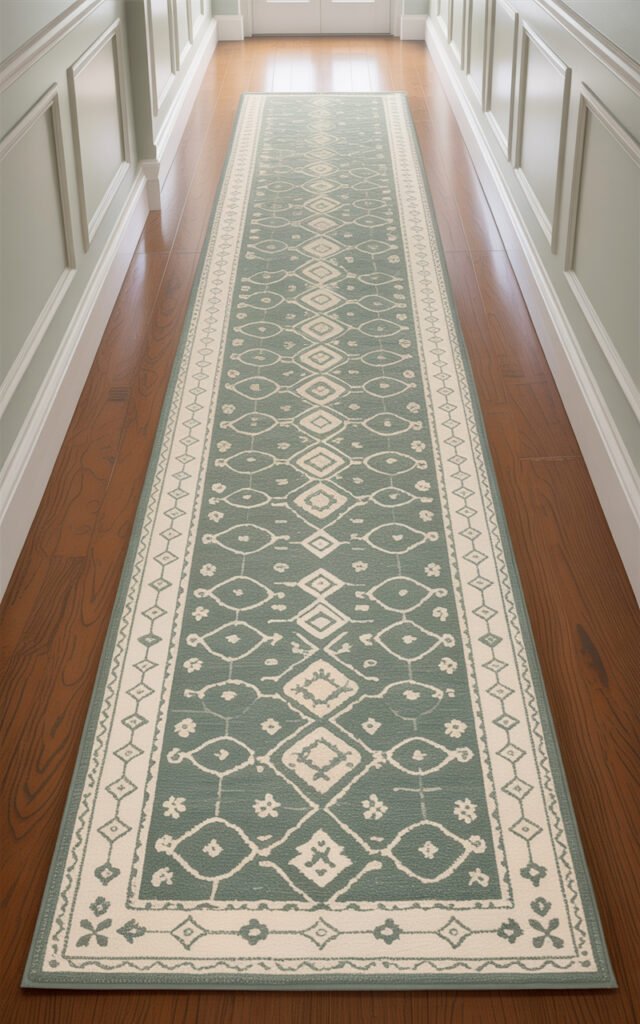
Choosing a hallway runner:
- Width: Leave 4-6 inches of floor showing on each side
- Length: Should run most of the hallway length (not awkward short sections)
- Pattern: Complements but doesn’t compete with wallpaper
- Durability: Hallways are high-traffic, so quality matters
- Color: Light enough to not close in the space, but not stark white (shows dirt)
I’ve got a light gray geometric runner from RugsUSA ($120 on sale for my 25-foot hallway) and it’s held up surprisingly well for two years now. Easy to vacuum, hides minor dirt, and adds that finished look.
Rug Pad: Don’t Skip This
Rug pads keep runners from slipping (safety!) and add cushion. They’re like $30-40 and completely worth it. I learned this the hard way when my first runner kept bunching up and was a tripping hazard.
Small Details That Matter
Once you’ve handled the big elements (walls, lighting, flooring), small details make the difference between “nice” and “wow.”
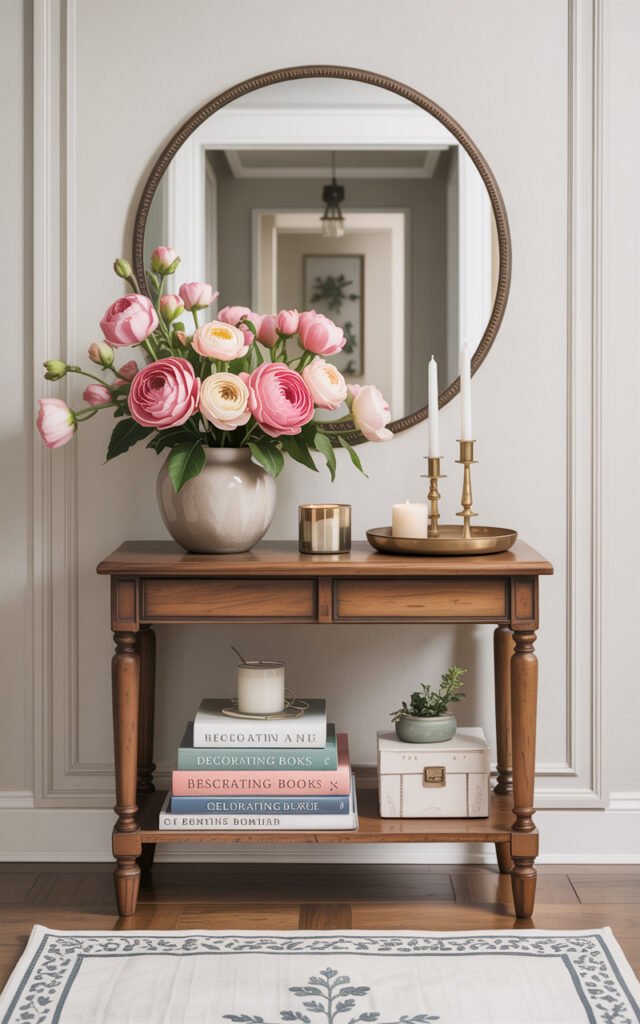
Finishing touches:
- Fresh flowers or faux stems on console tables
- A nice scent (candle or diffuser)
- Books stacked on consoles
- Decorative boxes or trays for visual interest
- One unique object that sparks conversation
In the image, there’s a simple vase with flowers on the console. That’s probably a $10 detail, but it adds life and freshness that completes the look.
I keep a brass tray on one console with a small plant and a candle. On the other console, I’ve got a stack of decorating books (thrifted for $2 each) and a sculptural object I found at HomeGoods for $15. Small investments, big impact.
Dealing With Doors
Long hallways often have multiple doors opening off them, which can make decorating tricky.
Working around doors:
- Keep decor between doors, not competing with them
- Use the spaces above doors for art if wall space is limited
- Consider painting all doors the same color for unity
- Ensure nothing blocks doors from opening fully
- Use door hardware as an accent (matching finishes throughout)
My hallway has four doors, so I strategically placed my consoles and art in the uninterrupted wall sections. The doors actually help break up the length naturally, so I work with them rather than against them.
Maintenance: Keeping It Looking Good
Long hallways are high-traffic areas. They need regular maintenance to stay looking polished.
Weekly maintenance:
- Vacuum or sweep the runner
- Dust consoles and decor
- Wipe down light switches and door handles
- Check that art and mirrors are straight
- Quick touch-up of any scuffs on walls
Monthly maintenance:
- Deep clean the runner
- Wash walls if needed (especially around light switches)
- Clean light fixtures
- Refresh flowers or styling elements
- Check for any damage to millwork or wallpaper edges
This seems like a lot, but it’s honestly 5-10 minutes weekly and maybe 30 minutes monthly. Worth it to keep your investment looking good.
Rental-Friendly Alternatives
Renting doesn’t mean you’re stuck with boring hallways.
No-damage options:
- Peel-and-stick wallpaper (removes cleanly)
- Removable picture frame molding (using Command strips)
- Battery-powered sconces (no hardwiring needed)
- Leaning mirrors instead of mounted ones
- Portable console tables and rugs
I rented for years and still did wallpaper (peel-and-stick), added wainscoting with command strips and adhesive (removed when I moved, no damage), and had plug-in sconces. Every security deposit came back in full.
Making It Feel Like Home
At the end of the day, your hallway should feel like it belongs to your home and reflects your style.
Personal touches:
- Family photos in beautiful frames
- Art or objects collected from travels
- Colors that make you happy
- Scents you love
- Details that spark joy when you see them
My hallway has three large botanical prints that remind me of a trip to Kew Gardens in London (good memories), smells like lavender (calming), and has this beautiful wallpaper I saved for months to afford. Every time I walk through, I appreciate it instead of just rushing past.
The Long View
Transforming a long hallway from forgotten tunnel to designed space doesn’t require a massive budget or professional help. It requires:
Smart wallpaper or paint choices that create interest, architectural details like wainscoting that add dimension, properly scaled and placed lighting that makes the space warm, console tables and mirrors that break up the length, and a runner rug that defines and unifies the space.
That’s it. Five elements, all achievable on a reasonable budget, all DIY-able if you’re willing to put in a weekend or two.
Whether you’re working with a narrow apartment corridor or a grand townhouse hallway, the principles are the same. Create visual interest, use your vertical space, break up the length, layer your lighting, and add those personal touches that make it yours.
Now go look at your hallway with fresh eyes. I bet it’s not as hopeless as you thought. 🙂