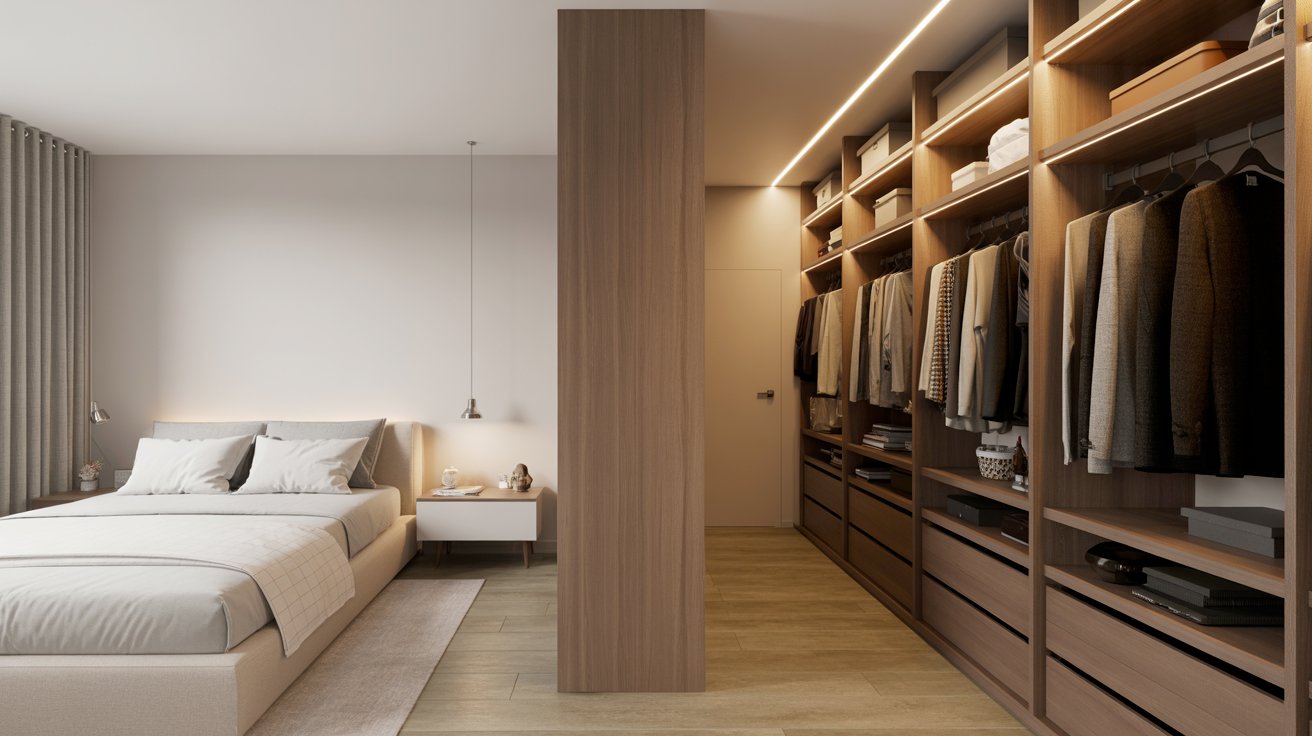
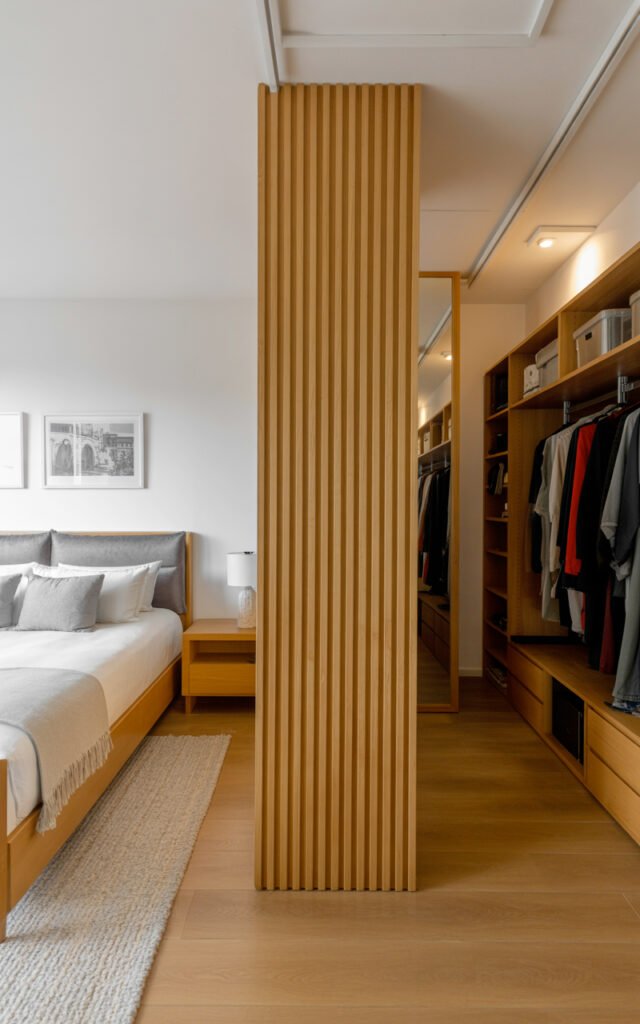
You know what’s wild? That image shows a small master bedroom with closet that looks like it belongs in a luxury apartment, but the whole space is probably smaller than most people’s living rooms. And yet – it works. The bedroom feels spacious, the walk-in closet is functional, and nothing feels cramped.
That’s the magic of smart bedroom with walk in closet layout plan design. It’s not about having massive square footage – it’s about using what you have so efficiently that it feels like more. Let me show you how to pull this off in your own small space.
The Open Closet Concept: Why It Works
That small room walking closet in the image isn’t hidden behind doors – it’s open and integrated into the bedroom. This is actually genius for small spaces.
Benefits of open walk-in closets:
- No door swing space needed (saves 2-3 feet)
- Makes small rooms feel larger (no visual barrier)
- Forces you to keep it organized (always visible)
- Creates a boutique hotel vibe
- Easier to access daily (no doors to open)
When open closets DON’T work:
- If you’re naturally messy and can’t commit to organization
- If dust is a major concern in your area
- If you have pets that shed heavily
- If the visual of clothes stresses you out
I was skeptical about open closets until I tried one in my small master bedroom. Turns out, having it always visible actually made me more organized because I couldn’t hide the mess behind doors.
The Divider Strategy: Defining Zones
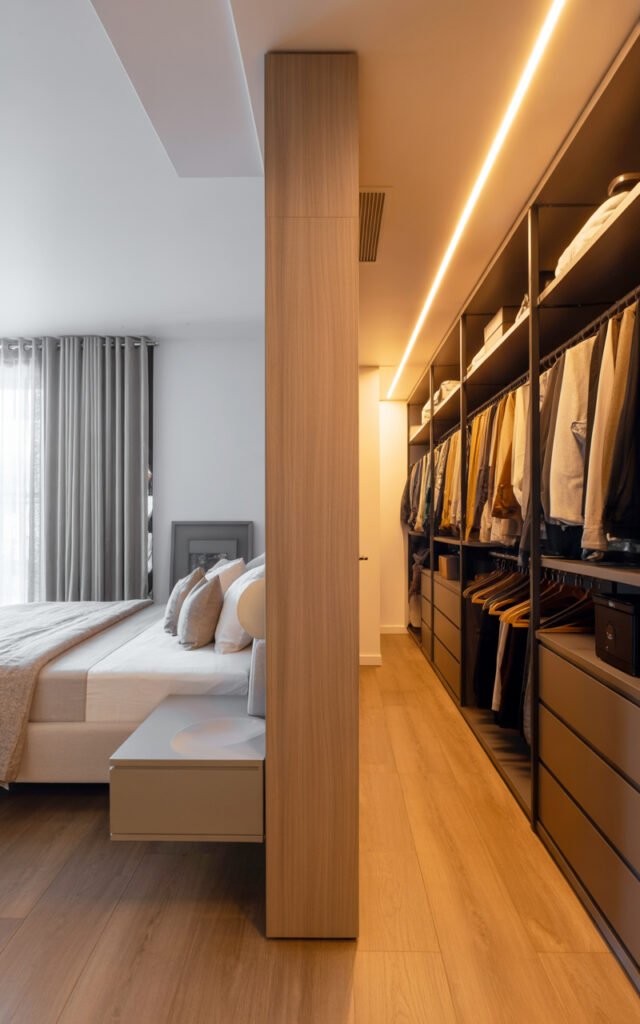
That wood column divider in the image? That’s doing serious work. It separates the sleeping zone from the closet zone without closing off the space.
Room divider options for small bedrooms:
- Wood or glass column (like in image)
- Half-wall with shelving
- Floor-to-ceiling shelving unit
- Sliding door or barn door
- Curtain or drapes (most flexible)
- Decorative screen
What makes a good divider:
- Doesn’t block light completely
- Feels intentional, not awkward
- Provides some visual privacy
- Adds to the design (not just functional)
- Doesn’t eat up floor space
The wood column in the image is perfect – it defines the zones clearly without making either space feel closed off or dark.
DIY Divider Solutions
If you’re on a budget or renting, permanent dividers might not work.
Temporary options:
- IKEA PAX wardrobe as a divider
- Bookshelf turned perpendicular to wall
- Tension rod with floor-length curtains
- Large plants (sounds weird, works visually)
- Decorative folding screens
I used a tall bookshelf as a divider in my last apartment. One side faced the bedroom (styled with books and decor), the other side faced the closet (practical storage boxes). Worked great and moved with me.
Small Master Bedrooms With Closet: Layout Planning
Small master bedrooms with closet require careful layout planning. Every square foot matters.
Layout principles that work:
- Bed placement first (it’s the biggest piece)
- Walk path should be at least 24 inches wide
- Closet should be 4-6 feet deep minimum
- Consider traffic flow from door to bed to closet
- Leave space for nightstands (even small ones)
Common layout configurations:
L-Shape: Closet along one wall, bed on adjacent wall Parallel: Closet on one side, bed on opposite (works in narrow rooms) Behind-the-Bed: Closet behind headboard wall (requires room depth) Corner: Closet in corner, bed angled or against wall
The image uses an L-shape configuration – closet on the right, bed on the left, with the divider creating clear zones. This is the most common layout for good reason – it just works.
Room With Closet Small Spaces: Maximizing Every Inch
Room with closet small spaces demands that every design choice serves multiple purposes.
Space-maximizing strategies:
- Floating nightstands (no floor space used)
- Under-bed storage
- Closet lighting that illuminates both spaces
- Mirrors to create depth illusion
- Vertical storage in closet
- Minimal furniture (only essentials)
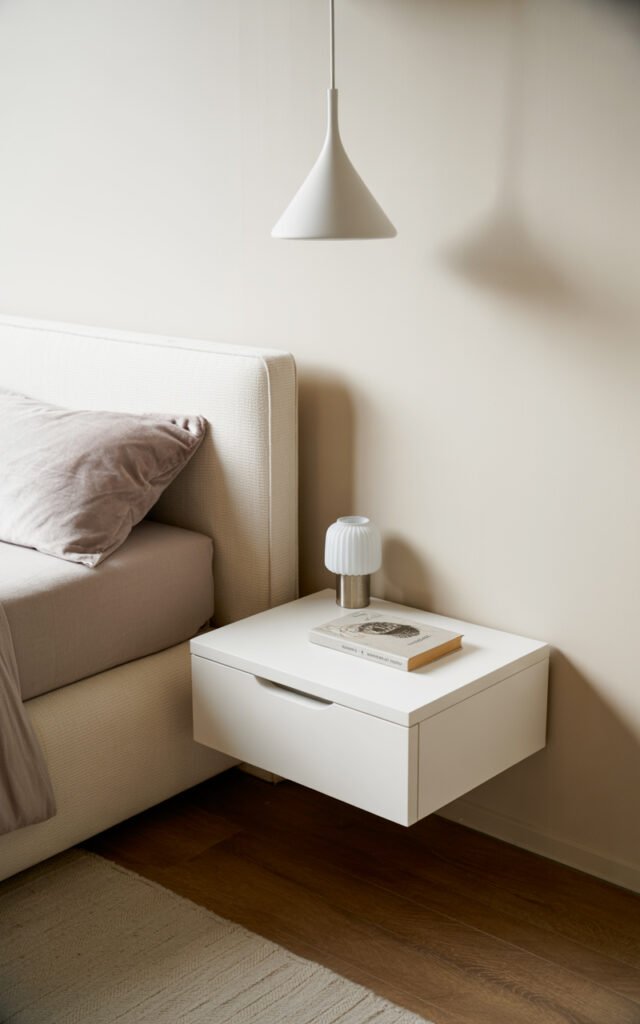
Notice the image has a floating white nightstand? That’s intentional. It provides bedside function without eating visual or actual floor space.
The Bed Choice Matters
In small bedrooms with walk-in closets, bed size is a real consideration.
Bed size for small spaces:
- Queen is usually the sweet spot (comfortable, not overwhelming)
- King if room is at least 12×14 feet
- Full/Double if under 10×12 feet
Don’t sacrifice your sleep quality for a massive bed that makes the room unusable. I downsized from a king to a queen when I moved to a smaller master bedroom, and honestly? I don’t miss the extra 16 inches. The functional space I gained was worth it.
Minimal Room Design Bedroom Ideas: Less Is More
The minimal room design bedroom ideas approach is perfect for small spaces with walk-in closets.
Minimal bedroom essentials:
- Bed (obviously)
- One or two nightstands
- Lighting (bedside and overhead)
- Window treatment
- Maybe one chair if space allows
What you DON’T need:
- Dresser (your walk-in closet handles this)
- Excessive decor
- Large furniture pieces
- Clutter on surfaces
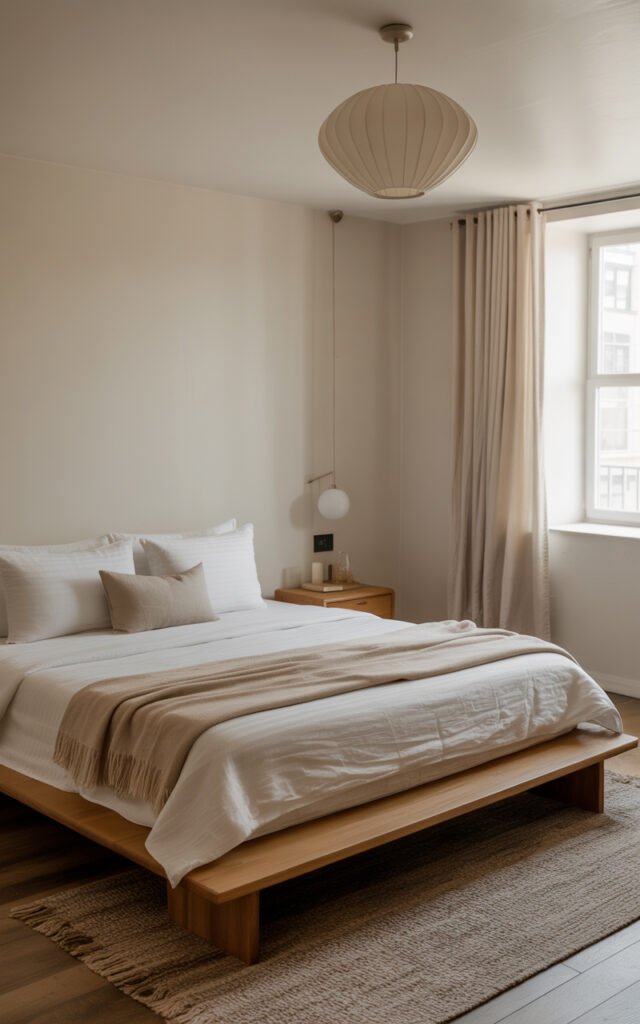
The image is incredibly minimal – bed, one nightstand, one pendant light, curtains. That’s basically it. And it looks expensive and intentional, not sparse or sad.
Creating Visual Calm
Minimal design in small spaces requires discipline.
Maintaining minimalism:
- Everything has a home (in the closet)
- No clothes on chairs or floor
- Nightstand has only essentials
- Under-bed storage for out-of-season items
- Regular decluttering (monthly minimum)
I follow the “one in, one out” rule with clothes. New shirt? Old shirt gets donated. It’s the only way I maintain my small space sanity.
Bedroom With Walk In Closet Layout Plan: The Numbers
Let’s talk actual dimensions for bedroom with walk in closet layout plan design.
Minimum dimensions that work:
- Total bedroom: 10×12 feet minimum
- Closet section: 4-6 feet deep, 5-8 feet wide
- Bedroom section: Remaining space (at least 9×10 for queen bed)
- Walking path: 24-36 inches (30 is comfortable)
Ideal dimensions if you have them:
- Total bedroom: 12×14 feet or larger
- Closet section: 6-7 feet deep, 6-10 feet wide
- Bedroom section: 10×12 feet for queen bed with breathing room
- Walking path: 36+ inches
The image looks like it’s working with maybe 12×14 feet total – not huge, but enough to make both zones functional when planned correctly.
Bedroom Closet Inspirations: Styling The Open Closet
Bedroom closet inspirations for open layouts require a different approach than hidden closets.
Open closet styling rules:
- Organize by color (creates visual calm)
- Use matching hangers (this matters more than you think)
- Store less-attractive items in drawers or boxes
- Display shoes and bags beautifully
- Keep everything neat (always, not just sometimes)
Making it look expensive:
- LED strip lighting (warm white)
- Wood or quality laminate finishes
- Gold or brass hardware
- Uniform storage boxes
- One or two decorative objects
The closet in the image is clearly well-organized with coordinated clothing and good lighting. That’s what makes it look like a boutique instead of just… clothes on shelves.
Lighting Your Walk-In Closet
Closet lighting is non-negotiable, especially in open layouts.
Closet lighting options:
- LED strip lights on shelves (what the image has)
- Recessed spotlights in ceiling
- Track lighting
- Battery-operated puck lights (renter-friendly)
- Motion-sensor closet lights
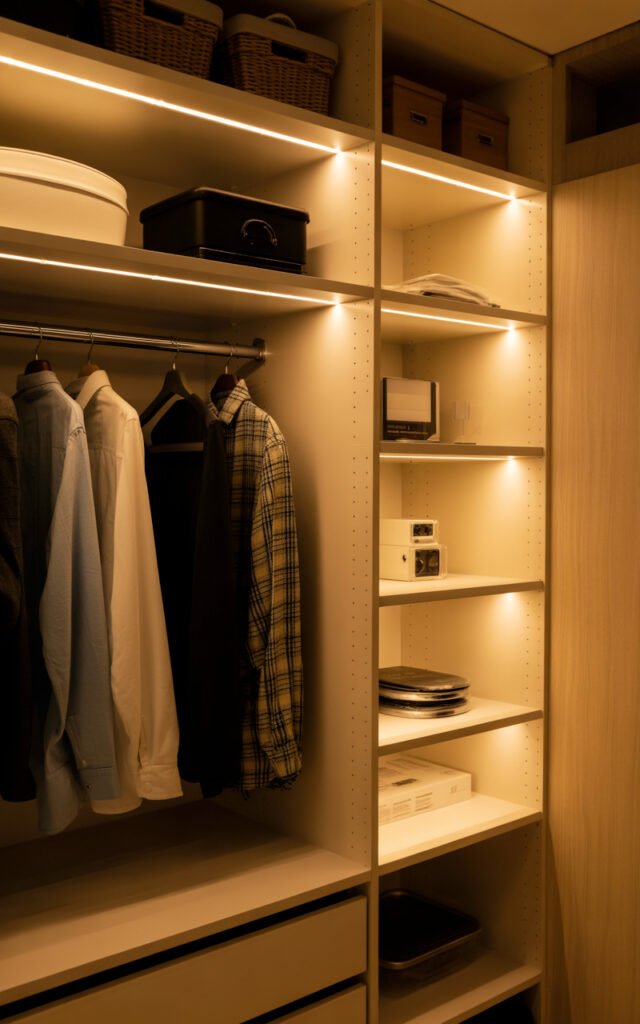
The warm LED strip lighting in the image does two jobs: illuminates the clothes for function AND creates ambient mood lighting for the bedroom. Smart.
Small House Maximize Space: Every Surface Counts
Small house maximize space principles apply perfectly to bedroom-closet combos.
Vertical space usage:
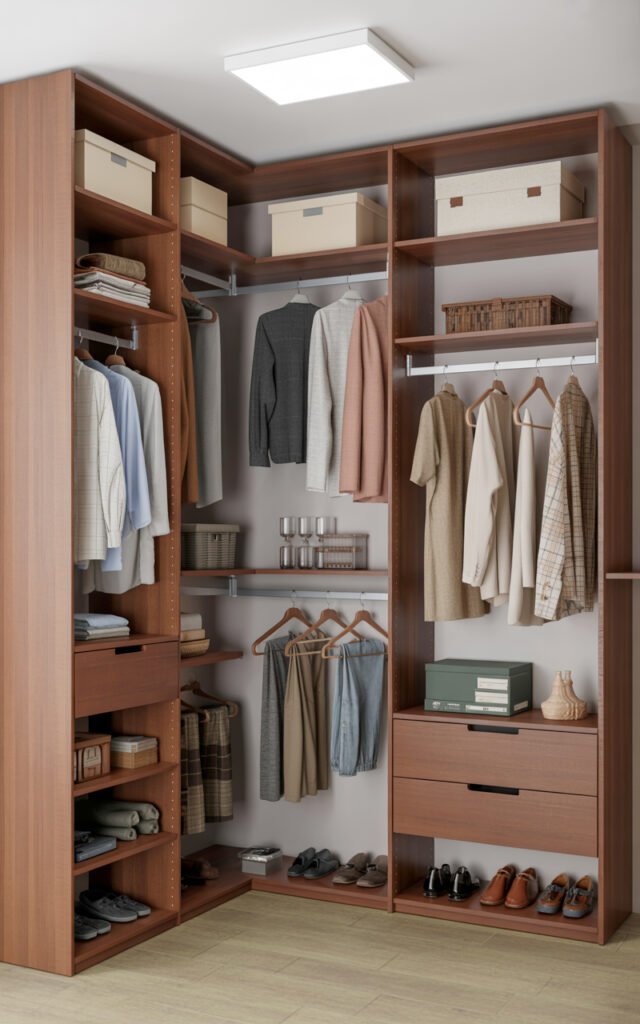
- Floor-to-ceiling closet shelving (like in image)
- High shelves for out-of-season items
- Over-door hooks or storage
- Wall-mounted nightstands
- Tall narrow furniture
Hidden storage opportunities:
- Under-bed storage boxes
- Ottoman with storage at foot of bed
- Nightstand drawers
- Back of door (closet side)
The image’s closet goes nearly to the ceiling, maximizing vertical space. That’s where you store things you don’t need daily – way up high.
House Wardrobe Design: Custom Vs. Systems
House wardrobe design can be custom-built or use modular systems. Both can look great.
Custom built-in pros:
- Fits your exact space
- Can be truly beautiful
- Permanent and sturdy
- Adds home value
Custom built-in cons:
- Expensive ($2,000-10,000+)
- Permanent (can’t take with you)
- Requires professional installation
- Long lead time
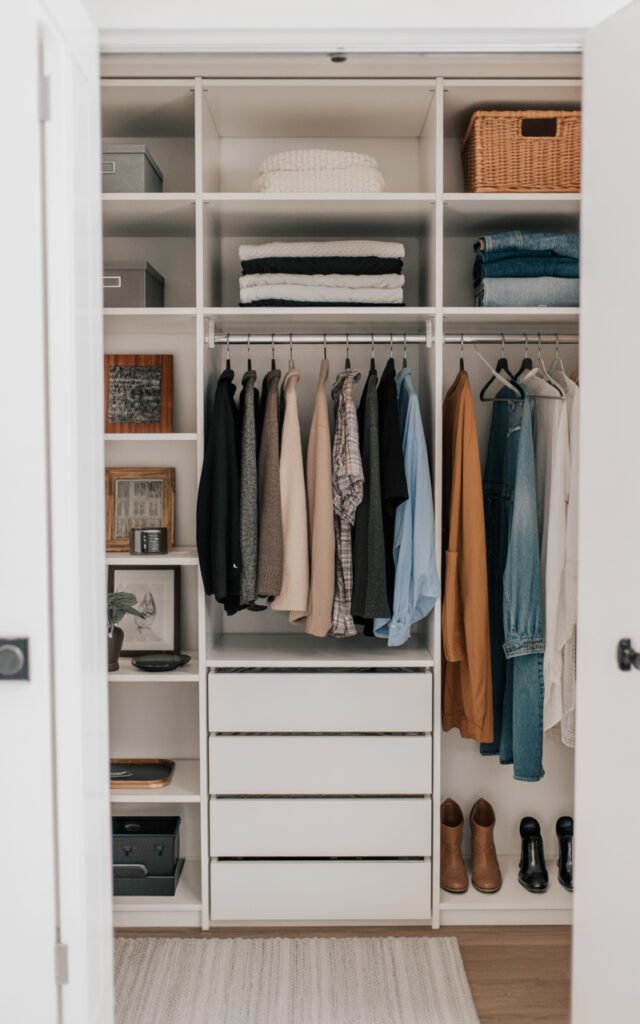
Modular system pros:
- Much cheaper ($500-2,000)
- Can reconfigure if needs change
- DIY-friendly installation
- Take it when you move
Modular system cons:
- May not fit perfectly
- Can look less custom
- Weight limits on shelves
- Requires assembly
I used IKEA PAX system in my walk-in closet. Total cost: about $1,200 for a 8-foot section with all accessories. Looks built-in, functions perfectly, and I can take it when I move.
Small Walking Wardrobe Ideas: Organization Systems
Small walking wardrobe ideas require smart organization to stay functional.
Essential closet components:
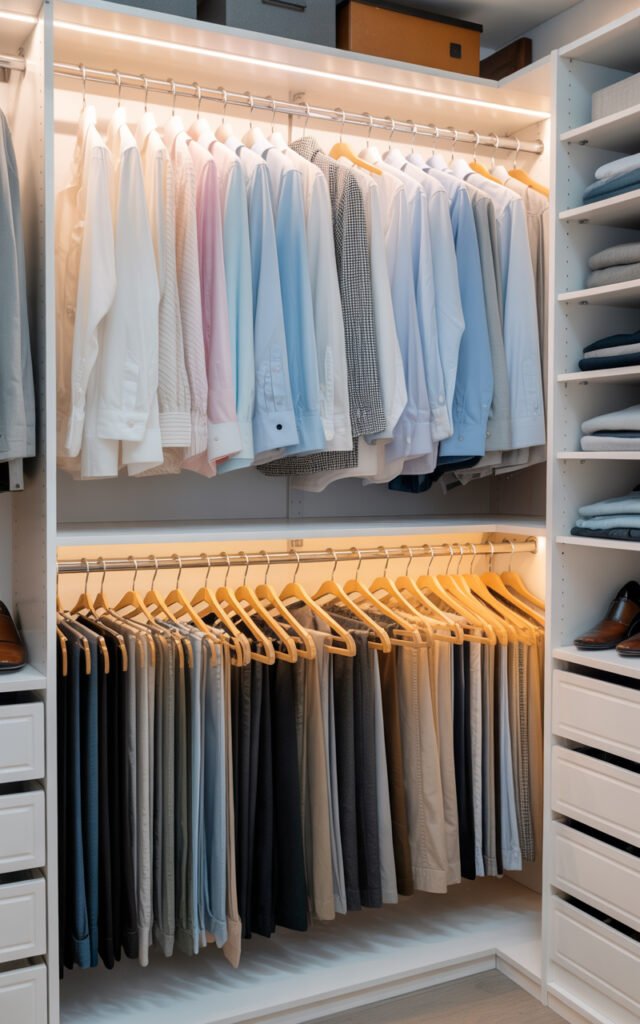
- Double-hang rods (shirts above, pants below)
- Shelving for folded items and shoes
- Drawers for accessories and intimates
- Hooks for bags or jewelry
- Full-length mirror
Organization products worth buying:
- Velvet hangers (slim and non-slip)
- Clear acrylic drawer dividers
- Matching storage boxes for shelves
- Shoe racks or shelves
- Belt/scarf hangers
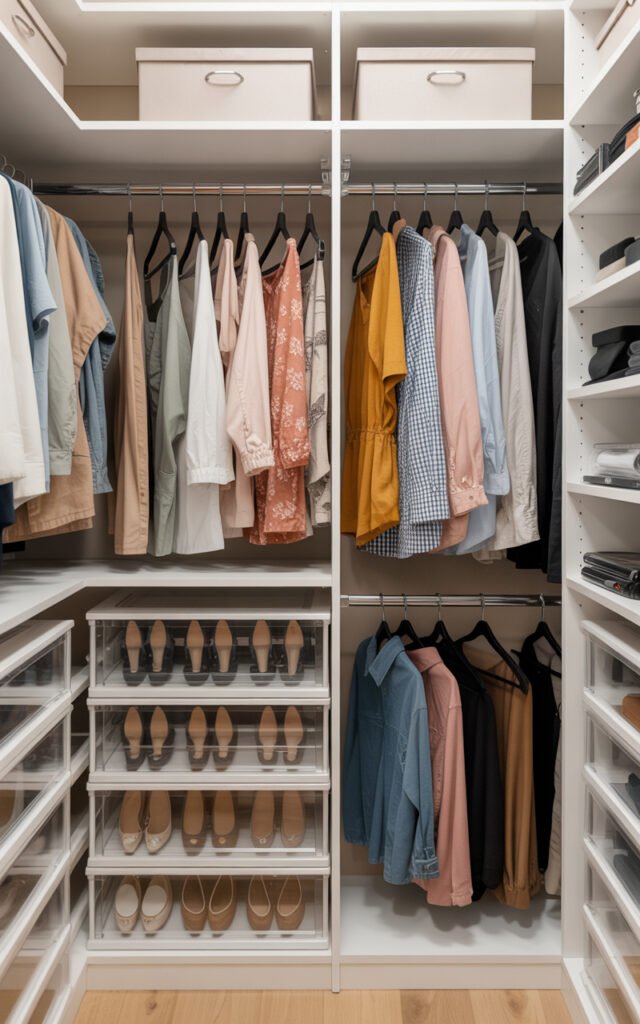
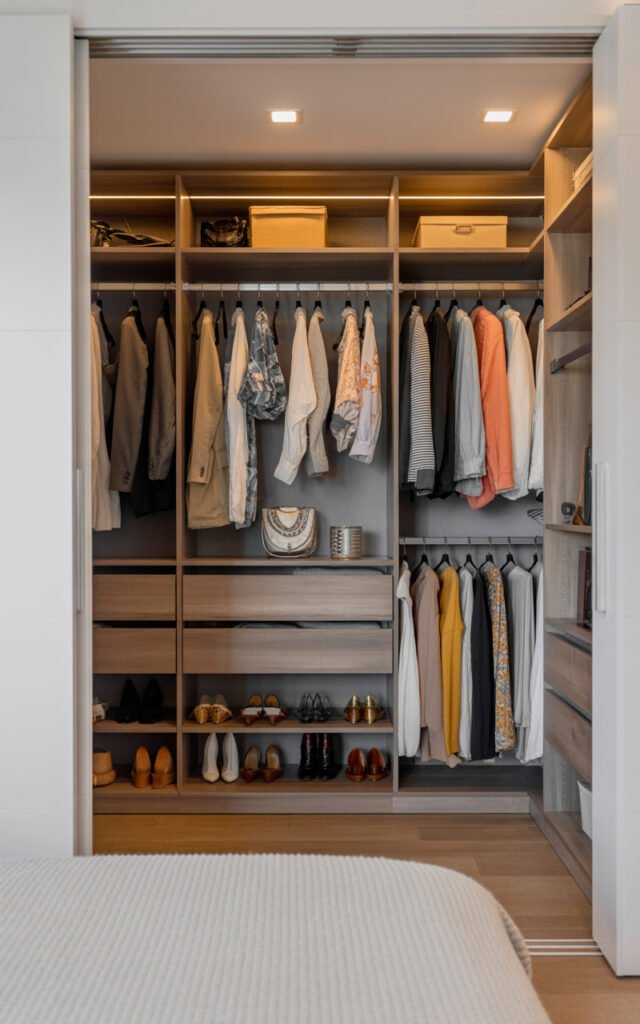
The image shows a well-thought-out system: hanging rods at multiple heights, open shelving for shoes and folded items, drawers (probably for smaller items), and organized zones for different clothing types.
The KonMari Influence
Marie Kondo’s methods work especially well in small walk-in closets.
KonMari principles for closets:
- Only keep what sparks joy
- File-fold clothes in drawers
- Organize by category
- Give everything a home
- Keep similar items together
I KonMari’d my closet two years ago and donated 40% of my clothes. Turns out I didn’t need that much stuff, and my small closet functions way better with less.
Window Treatment Considerations
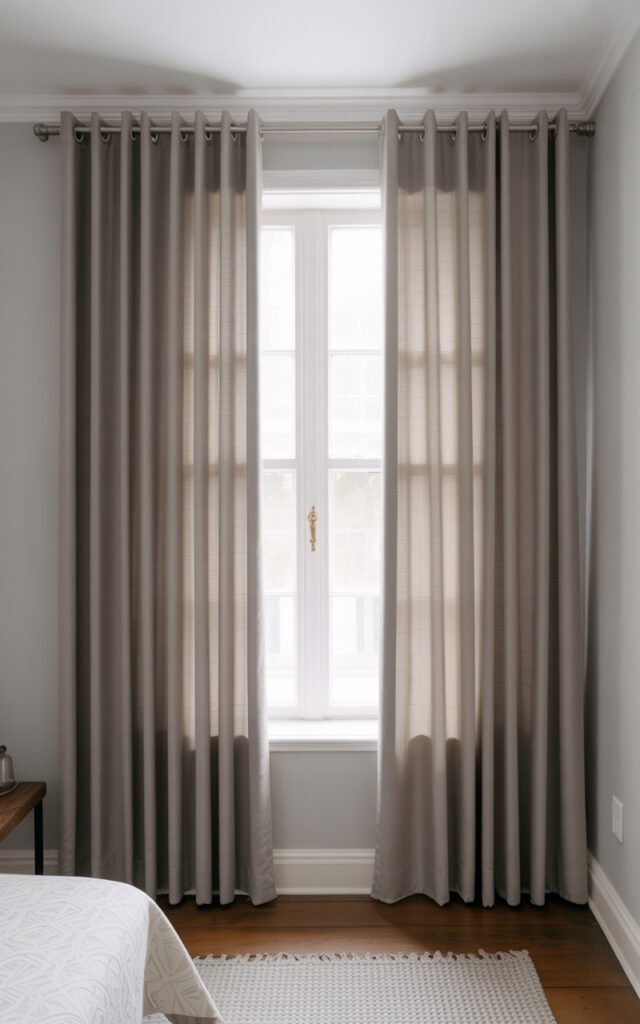
That long curtain in the image? That’s doing more than you think.
Window treatments in bedroom-closet combos:
- Floor-length looks more expensive
- Light-filtering during day, privacy at night
- Mounted high makes ceiling look taller
- Neutral colors keep it calm
- Consider blackout lining for sleep quality
Mounting tips:
- Mount rod close to ceiling
- Extend rod 6-12 inches past window frame
- Let curtains just touch or puddle slightly on floor
- Use quality hardware that won’t sag
I spent $80 on good curtains and $40 on proper hardware, and it made my room look twice as expensive. Worth every penny in a small space where everything is visible.
Flooring: Creating Continuity
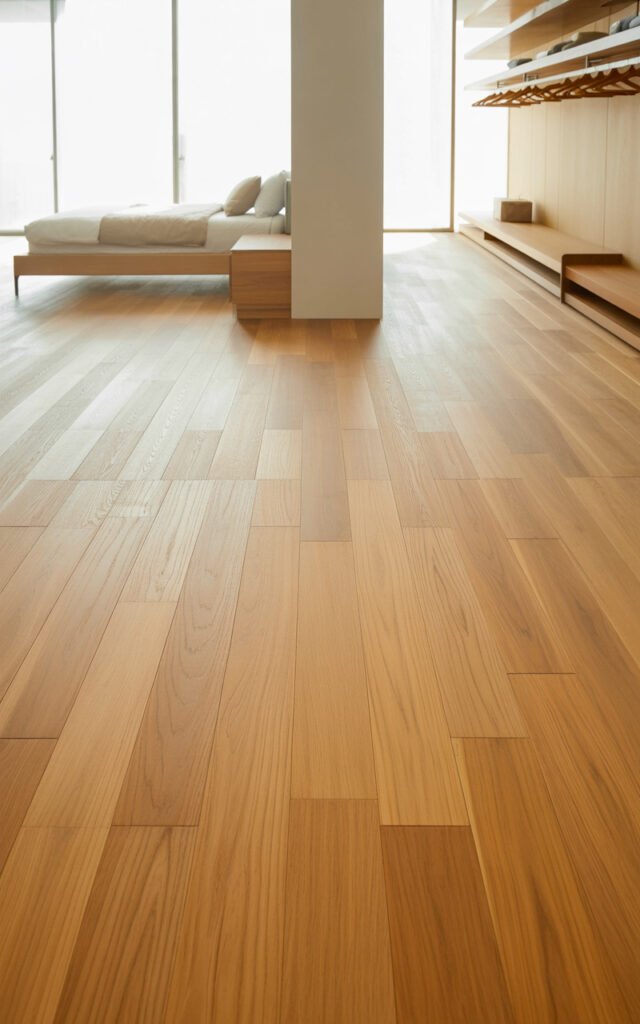
The image uses the same light wood flooring throughout both zones. This is strategic.
Flooring for small bedroom-closet combos:
- Use same flooring in both spaces
- Light colors make spaces feel larger
- Wood or wood-look is classic
- Avoid busy patterns
- Consider a small rug beside bed only
Why continuity matters:
- Creates visual flow
- Makes spaces feel connected
- Doesn’t chop up the room visually
- Easier to maintain (one cleaning method)
Color Palette: Keeping It Cohesive
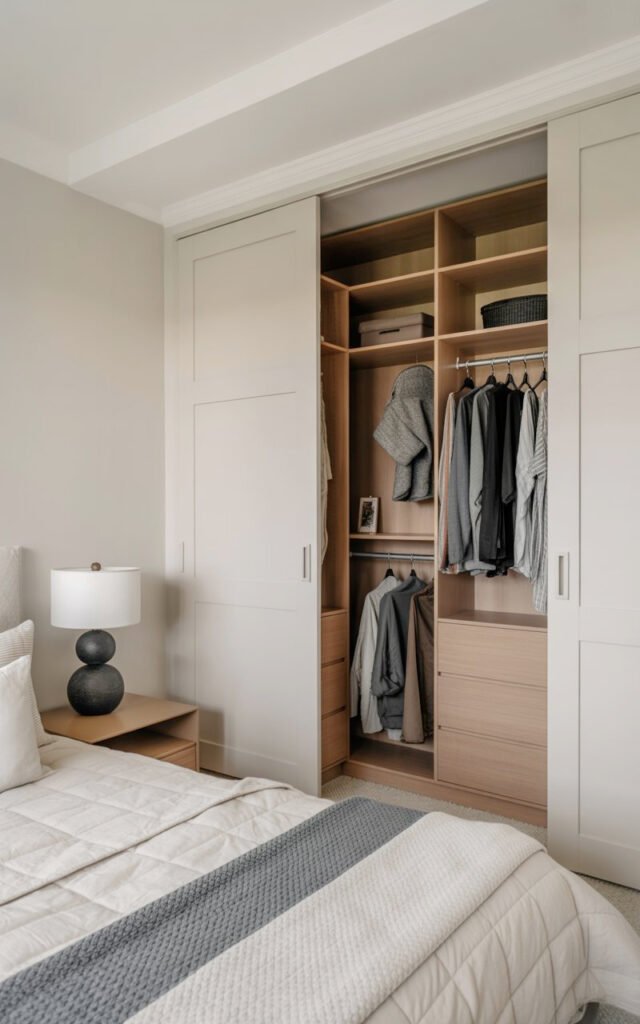
The image uses a neutral palette: white, wood tones, gray. This is intentional for small spaces.
Color strategy:
- 3-4 colors maximum across both zones
- Neutral base (white, beige, gray)
- Wood tones count as a neutral
- Pops of color in closet (clothes) provide interest
- Keep walls and large pieces neutral
Why neutrals work in small spaces:
- Don’t overwhelm visually
- Make spaces feel larger
- Easy to style and change
- Always look current
- Let architecture shine
Budget Breakdown: What This Costs
Let’s be real about creating this look.
DIY Budget ($1,500-3,000):
- IKEA PAX or similar closet system ($800-1,500)
- Paint and divider materials ($200-400)
- LED lighting ($100-200)
- Organization accessories ($200-400)
- Curtains and hardware ($200-500)
Mid-Range Budget ($3,000-6,000):
- Better closet system or partial custom ($1,500-3,000)
- Higher quality materials ($400-800)
- Professional installation for some elements ($500-1,000)
- Better lighting ($200-400)
- Quality finishing touches ($400-800)
High-End Budget ($6,000-15,000+):
- Full custom closet build ($3,000-8,000)
- Custom divider/wall ($1,000-3,000)
- Designer lighting ($500-2,000)
- High-end finishes and hardware ($1,000-2,000)
- Professional design and installation ($1,500+)
Most people can achieve this look in the $2,000-4,000 range with smart shopping and some DIY work.
Common Mistakes To Avoid
Don’t sacrifice bed size unnecessarily. Figure out what you actually need before downsizing.
Don’t make walking paths too narrow. 24 inches absolute minimum, 30+ is comfortable.
Don’t skip closet lighting. Dark closets in bedrooms make the whole space feel dim.
Don’t forget ventilation. Open closets need air circulation to prevent musty smells.
Don’t overcomplicate the divider. Simple is usually better in small spaces.
Making It Work For Different Lifestyles
For minimalists: This layout is perfect. Keep only essentials, enjoy the open flow.
For fashion lovers: Requires discipline but the display aspect is satisfying.
For couples: Divide closet into his/hers sections clearly.
For renters: Use temporary dividers and modular closet systems.
For messy people: Consider adding doors or curtains you can close when needed.
Maintenance Reality Check
Open walk-in closets require more upkeep than closed ones.
Daily maintenance:
- Put clothes away immediately (not on chair)
- Make bed (visible from closet side)
- Keep closet floor clear
Weekly maintenance:
- Dust closet shelves
- Straighten clothes on hangers
- Check for items that belong elsewhere
Monthly maintenance:
- Deep clean closet
- Reassess organization
- Donate items you haven’t worn
This is maybe 5 minutes daily, 15 minutes weekly. The trade-off for living in a functional beautiful small space.
The Final Walkthrough
Creating a functional small master bedroom with closet comes down to open layout with smart divider, vertical storage maximizing every inch, minimal bedroom furniture (bed and nightstand), well-organized closet with matching systems, and cohesive neutral color palette throughout.
That’s it. Five principles that work whether you’re working with 120 square feet or 200 square feet, whether you’re building custom or using IKEA, whether your budget is $1,500 or $15,000.
The image you’re looking at isn’t magic or unlimited space – it’s smart planning that makes a small bedroom and walk-in closet coexist beautifully. And honestly? That’s way more impressive than having a massive room where you can throw stuff wherever.
Your small master bedroom can have a walk-in closet. It just needs to be planned right.
Now go measure your space and start planning. You’ve got this. 🙂